
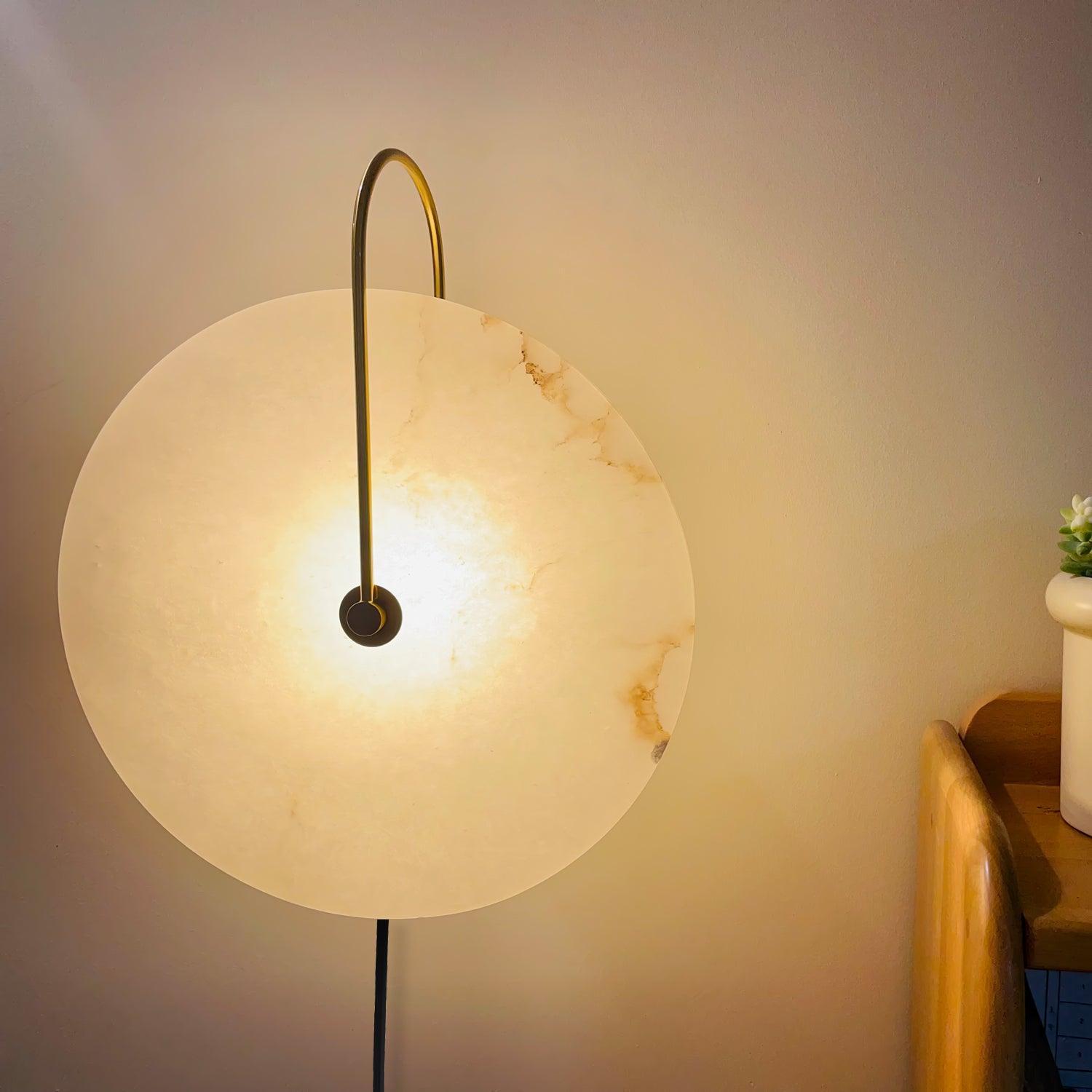
Alabaster is a fine-grained, translucent form of gypsum — chemically calcium sulfate dihydrate (CaSO₄·2H₂O). It is soft enough to be scratched by a fingernail, yet thin panels pass a remarkable amount of light. That unlikely combination — a stone that behaves like a soft, glowing membrane — is why alabaster has been carved into lamps and light screens for several thousand years, and why it still reads as unmistakably different from glass, acrylic, or fabric.
Alabaster lighting means fixtures in which the light source is concealed behind alabaster stone rather than a shade or clear glass. You see a solid pale stone while it is off. Switch it on and the stone turns into a warm, evenly lit surface with no visible bulb, no glare, and no hard-edged beam.
This guide covers what alabaster actually is, how it behaves under light, where it comes from, what it costs, and how to choose and care for it. It is written for people furnishing a home and for anyone trying to understand why one alabaster lamp sells for $300 and another for $3,000.
Quick Answer
| Question | Short answer |
|---|---|
| What is alabaster? | A compact, fine-grained variety of gypsum (hydrated calcium sulfate) |
| Why is it used for lighting? | It is highly translucent — it diffuses light instead of blocking or focusing it |
| Is it the same as marble? | No. Alabaster is far softer and far more translucent; marble is harder and mostly opaque |
| Is it fragile? | It scratches and chips easily, and it is sensitive to water and long-term moisture |
| Can it be used outdoors? | Not recommended, particularly anywhere it can freeze |
| How do you clean it? | A barely damp cloth, dried immediately. No solvents, no soaking |
What Is Alabaster, Exactly?
Alabaster has been a confusing word for about two thousand years. In antiquity it referred to almost any pale, carveable stone. Today the trade uses it for two entirely different minerals, and only one of them is what you are buying when you shop for alabaster lighting.
The Two Stones Called "Alabaster"
Gypsum alabaster is calcium sulfate dihydrate. It is soft, slightly soluble in water, and genuinely translucent. Essentially all decorative alabaster in the market today is this type, and it is the material used in alabaster lighting.
Calcite alabaster is calcium carbonate — chemically the same family as limestone and marble. It is harder, denser, and largely opaque, and it is more resistant to acids but more vulnerable to weathering. It was used in ancient Egyptian vessels and Italian sculpture. It is not what a lighting fixture is made from.
The distinction matters when you are evaluating a product. Gypsum alabaster's defining properties — softness, water sensitivity, and light transmission — all follow from it being gypsum.
What Alabaster Is Made Of
| Property | Value |
|---|---|
| Chemical composition | Calcium sulfate dihydrate, CaSO₄·2H₂O (typically 95–99% purity) |
| Water of crystallization | ~21% by weight — this is where the translucency comes from |
| Mohs hardness | 1.5 – 2.0 (by comparison: marble 3–4, granite 6–7) |
| Density | ~2.2 – 2.4 g/cm³ |
| Crystal structure | Monoclinic, fine-grained and compact |
| Solubility | Slightly soluble in water |
| Dehydration temperature | ~100 – 150 °C, above which it converts toward plaster of Paris |
| Colour | White, cream, honey, pale grey; often with brown or reddish veining |
Two numbers here are worth pausing on.
Hardness 1.5–2 means alabaster sits at the very bottom of the mineral hardness scale, alongside talc. It can be marked by a fingernail. This is why alabaster is so easy to carve into thin, even sections — and also why it demands care in a household.
Dehydration at 100–150 °C is the single most important technical fact for anyone buying an alabaster light fixture. The stone's translucency depends on water held inside its crystal structure. Sustained heat drives that water out. In practice this means an alabaster shade is not a suitable home for a hot incandescent bulb pressed close to the stone. Alabaster lighting and modern LED sources belong together — the LED runs cool, so the stone stays stable. If you are retrofitting an older alabaster fixture, choose a low-heat LED bulb, and keep some airflow between the bulb and the stone.
Why Alabaster Glows the Way It Does
Alabaster's defining characteristic is that it transmits light rather than reflecting it or blocking it.
Light transmission depends on thickness, purity, and veining, and it varies block to block. As a practical guide: a panel in the 15 mm range — typical for a lamp shade — passes roughly a third to nearly half of the light that hits it, which is why a small bulb can light an entire stone body. Thinner sections in the 6–10 mm range glow almost uniformly, edge to edge, with no hot spot. The thinnest, clearest alabaster can transmit considerably more, and some sources cite figures approaching 70% for suitably thin sheet. Treat these as ranges, not specifications: the only reliable way to judge a particular piece is to put it in front of a light.
Three consequences follow, and they explain almost everything about how alabaster lighting looks.
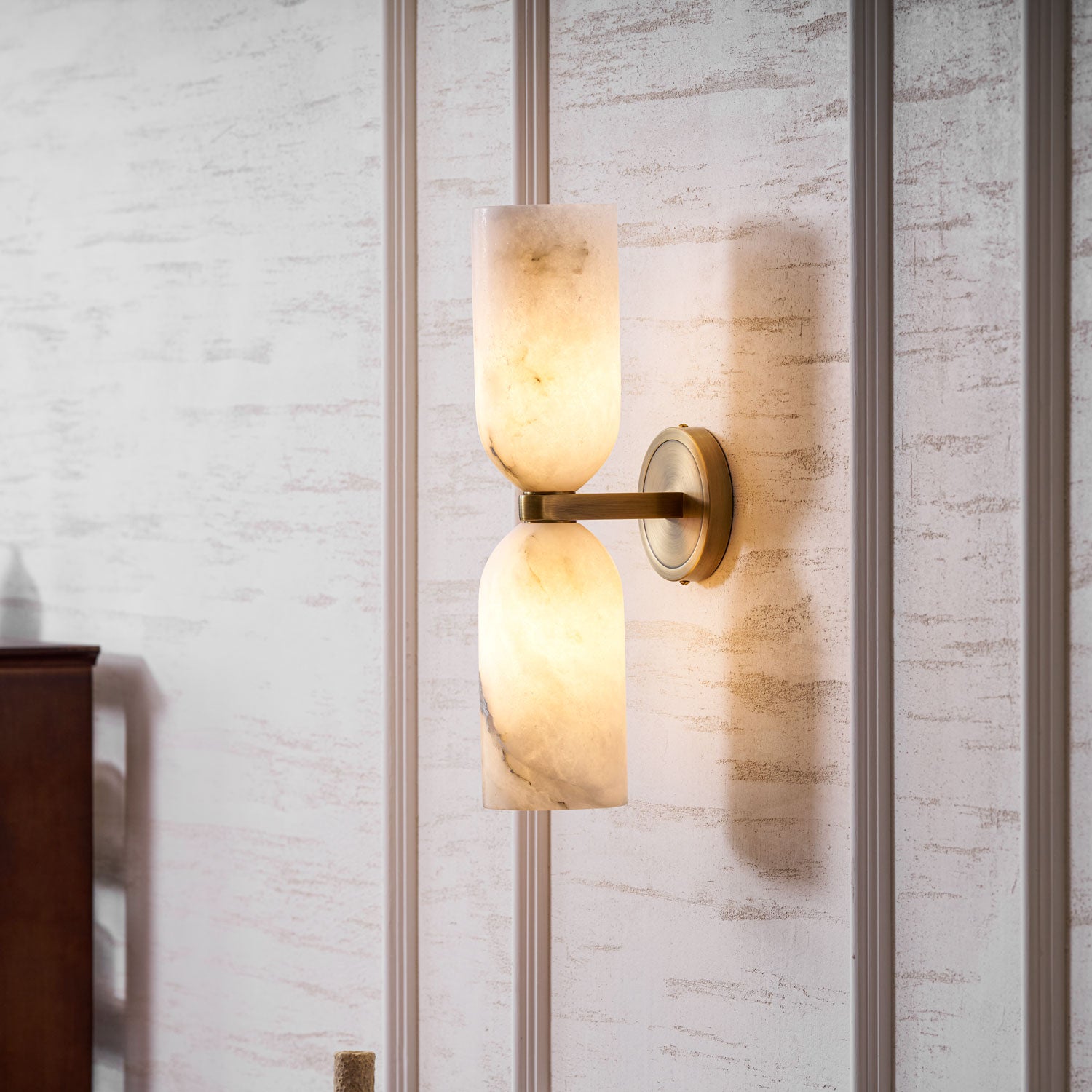
Light is diffused, not focused. Passing through a scattering crystalline matrix, light emerges soft and directionless — no visible filament, no bright core, no glare. That is the opposite of a bare bulb or a clear glass pendant, and it is why alabaster suits bedrooms and dining rooms, where a bright point source is uncomfortable at eye level.
Veining becomes the design. In ambient light a panel looks like pale, subtly patterned stone. Backlit, its internal structure becomes the image, every vein and density change reading as a variation in brightness. Because no two blocks are identical, no two lit fixtures are identical either — the variation is a property of the material, not a defect.
Colour temperature reads warmer. Passing light through warm-toned translucent stone shifts the perceived colour toward amber. The same bulb looks softer behind alabaster than behind fabric, which makes the material unusually forgiving where you want intimate light rather than working light.
Where Alabaster Comes From
Alabaster deposits occur in many parts of the world — Italy, Spain, Iran, Turkey, Egypt, Mexico, and the United States among them. Extraction in several of these regions has roots running back to Roman times, and the international trade in decorative alabaster is concentrated: a relatively small number of quarries supplies most of the world's semi-finished material.
Yields explain part of the price. Alabaster is brittle and heavily veined, so a large share of what comes out of the ground is discarded during cutting and shaping. You are paying, in part, for everything that did not survive the saw.
A note on origin claims. Some listings advertise a specific quarry region as a quality signal. That is meaningful only if it is verifiable. Origin is one of the things that separates a $300 lamp from a $3,000 one — but so are wall thickness, uniformity of colour, and how much of the stone is actually usable. If you are comparing fixtures, ask about the stone itself: how thick the sections are, whether the pieces are colour-matched, and how the light behaves as it passes through.
The Honest Trade-offs
Alabaster is not a universally better material. It is a material with a very specific set of strengths, and it makes sense to know where it is weak before you commit.
What it does well
- Diffused, glare-free light. Nothing else in the price range produces this quality of soft, even illumination.
- A genuine luxury signal. Natural stone reads differently from resin, acrylic, or fabric. The variation is visible and it is real.
- Colour stability. Alabaster does not absorb liquids and does not stain or discolour from everyday contact, so a well-cared-for piece holds its appearance for a very long time.
- Age and craft. Carving alabaster is slow, skilled work. A well-made alabaster fixture is closer to sculpture than to manufacture.
What it does poorly
- Scratches and chips. Softness is the trade-off for workability. It shows careless handling.
- Moisture sensitive. Gypsum is slightly soluble. Prolonged damp, standing water, or repeated soaking will damage the surface, and freezing conditions can crack it outright. Indoor use only.
- Yellowing from direct sun. Prolonged direct sunlight causes alabaster to yellow over time. Keep it out of full sun.
- Weight. At roughly 2.2–2.4 g/cm³, real alabaster is substantially heavier than resin imitations. That is a good sign for authenticity and a consideration for ceiling mounting.
- Cost. The material is expensive, the yield is low, and the labour is skilled. There is no version of this that is cheap.
Because alabaster is pale and sometimes veined, it is often mistaken for marble or onyx — but marble is harder and essentially opaque, so it will not glow, and onyx as the term is used in interiors is a banded calcite that behaves differently again under water and acid.
Alabaster in Lighting: Five Formats
The same stone takes very different characters depending on how it is cut and how much of it a given application needs.
Chandeliers — the most demanding use of the material. A chandelier is a composition problem: several stone bodies have to be matched for tone and veining so that the assembled piece reads as one object. It is also the format where alabaster's translucency matters most, since the fixture is the room's main light source. The Oval Alabaster & Brass Chandelier shows the approach at its most architectural — an elongated stone body framed in brass, sized for a dining table rather than a foyer. Our alabaster chandeliers cover the range from compact two-light pieces to larger linear forms.
Pendants — the most versatile format, and generally the most affordable way to own alabaster. A single stone cylinder or globe over a kitchen island or a bedside table gives you the diffused quality without the scale of a chandelier. The Modern Alabaster Hanging Pendant Light is a clean example: one hanging stone body, brass detailing, no visual noise. Pendants also work in multiples, which is how they are most often used over islands and in stairwells.
Floor lamps — here alabaster solves a specific problem. A floor lamp puts light near eye level, where a bare or clear-shaded bulb is uncomfortable. A stone body removes the glare entirely, and because it is opaque-looking when off, it reads as sculpture rather than as a lamp. The Catena Alabaster Floor Lamp is a sculptural reading of this — a stacked stone form that works as an object in the daytime and a soft light source at night.
Table lamps — the format most people meet alabaster through, and the easiest entry point. A stone table lamp on a bedside or console gives warm, low light that does not fight a screen. The Gardiner Alabaster Table Lamp is a straightforward, well-proportioned example. Because table lamps are small, the stone is usually thinner and the glow more even than in large fixtures.
Wall sconces — the format where alabaster's diffusion is least replaceable. A sconce sits at face height in a hallway, beside a bed, or flanking a fireplace. A clear glass or exposed-bulb sconce is a glare source at exactly the wrong height; an alabaster one glows evenly and lights the wall without dazzling anyone. The Elsa Alabaster Bowl Wall Sconce combines a stone bowl with integrated dimmable LED — which, given the heat point above, is the right engineering choice.
You can see the full range across our alabaster lighting collection, or start with the pieces that sell most consistently, in best-selling alabaster lamps.
How to Choose Alabaster Lighting
Size the fixture to the room, not to the photo. The standard rule for a chandelier over a table is easy to apply: add the room's length and width in feet; treat the total as the fixture's diameter in inches. A 12 × 14 ft dining room points to roughly a 26-inch fixture. Then check clearance: keep 30–36 inches between the tabletop and the bottom of the fixture. On a low ceiling, prioritise clearance — a slightly smaller fixture that hangs correctly looks better than a large one you have to duck under.
For pendants over an island, use odd numbers where the island suits it (three small pendants usually balance better than two) and keep the bottom of the pendants roughly 30–36 inches above the counter. For wall sconces, place the centre of the fixture 60–66 inches from the floor — eye level, not above it.
Use warm light. This is a rule, not a preference. Alabaster reads best at around 2700K with a high colour rendering index (90+). Warm light through translucent stone produces the amber glow the material is known for; cool white light in the 4000K range and above makes the stone look grey, cold, and occasionally faintly green. If the rest of the house is on cool-white bulbs, this is the fixture worth changing them for.
Choose LED, and dim it. Heat first: sustained exposure above roughly 100–150 °C drives the water out of the gypsum structure, so a hot incandescent bulb sealed inside a small stone shade is a genuinely bad idea, while a modern LED runs far below that threshold. Then control: alabaster lighting is atmosphere lighting, and a dimmer is what takes it from ambient wash to low glow. If you buy a fixture with integrated LED, confirm it is dimmable and check which dimmer protocol it expects.
Know where it should not go. Skip alabaster for heavily steamed bathrooms, covered outdoor areas, freezing climates, and windowsills in direct sun — the four conditions that damage it.
How to Care for Alabaster Lighting
Alabaster is low-maintenance if you keep two rules: very little water, and no chemicals.
Routine dusting. A dry, soft cloth or a soft brush. Dust is not harmful; it just dulls the translucency slightly.
Deeper cleaning. Use a cloth that is barely damp — wrung out, not wet — wipe the surface, and dry it immediately. The point is to avoid letting moisture sit on or penetrate the surface. Never soak an alabaster shade, and never put it in a dishwasher or sink.
Never use abrasive cleaners, ammonia, acidic products, solvents, or scouring pads. Alabaster is hardness 1.5–2: an abrasive cleaner will scratch it, and acidic products attack calcium sulfate.
No direct sunlight. Ultraviolet exposure causes yellowing over time. If a fixture sits in a sunlit window, consider moving it.
Wax annually. A thin application of a purpose-made stone wax once a year protects the surface and restores the depth of the finish. This is the standard recommendation in the stone trade and it is genuinely worth doing on a piece at this price point.
Handling. Carry stone bodies with both hands, avoid contact between alabaster and hard surfaces, and store spare shades padded and upright. Do not lift a fixture by the stone body.
How to Tell Real Alabaster from "Alabaster-Style" Resin
"Alabaster style," "alabaster look," and "alabaster finish" almost always mean resin or composite. There is nothing wrong with resin on its own terms — it is tough, cheap, and consistent — but it is a different product, and it should not be priced as stone. Four checks:
| Check | Real alabaster | Resin imitation |
|---|---|---|
| Weight | Noticeably heavy for its size (density ~2.2–2.4 g/cm³) | Light; often much lighter than it looks |
| Temperature | Feels cool to the touch, like stone | Feels neutral or warm, like plastic |
| Veining | Irregular, asymmetric, unique — varies across the surface | Repeating, mirrored, or suspiciously uniform patterns (mould seams are a giveaway) |
| Light behaviour | Glow varies with thickness — thin areas brighter, denser areas darker; veins visible in the light | Glow is flat and even; the pattern does not correspond to brightness |
A fifth check, if you can hold it up to a lamp: resin transmits light uniformly because it is homogeneous. Alabaster does not — its internal structure shapes the light, which is the whole reason it looks the way it does.
Frequently Asked Questions
Is alabaster glass? No. It is a natural stone — a fine-grained form of gypsum. Glass is manufactured and amorphous; alabaster is crystalline, quarried, and cut. The confusion arises because both can be translucent and pale, but alabaster diffuses light through its internal mineral structure and behaves completely differently when handled.
Is alabaster the same as marble? No. Marble is chemically different (calcium carbonate rather than calcium sulfate) and physically different in every way that matters here: marble is harder (Mohs 3–4 versus alabaster's 1.5–2) and essentially opaque. Marble is a structural and cladding material; alabaster is a light-diffusing one.
Does alabaster lighting look yellow? The stone itself is white or cream with natural veining, and it does not yellow on its own indoors. Two things cause a yellow or dulled appearance: prolonged direct sunlight, and the bulb you choose. Pair alabaster with warm white LED around 2700K and high CRI for the intended glow, and keep it out of direct sun.
Can alabaster lamps be used in a bathroom? Generally avoid it. Alabaster is slightly soluble in water and sensitive to sustained humidity, so a frequently steamed bathroom is one of the worst environments for it. Powder rooms with good ventilation are a better fit than full bathrooms.
Why is alabaster lighting expensive? Three reasons: the raw material is quarried and heavily sorted, so a large share is discarded before anything is made; carving and matching stone bodies is skilled, slow work; and producing a fixture where several stone pieces must match in tone and veining adds production complexity. The material's translucency — the thing you are actually buying — is also the property that is hardest to source consistently.
Will an alabaster fixture look the same as the product photo? Not exactly, and that is expected. Alabaster is a natural material; veining and density vary from block to block, so tone and pattern differ slightly between individual pieces, including between two of the same model. Thickness and finishing are what manufacturers control; the internal landscape is the stone's own.
The short version: alabaster is a soft, translucent stone, not glass, marble, or resin. It rewards careful use — LED rather than incandescent, warm rather than cool, a dimmer rather than a hard switch, and a barely damp cloth rather than anything that sprays or soaks. If you are choosing your first piece, start where the material does the most work: a wall sconce, a table lamp, or a single pendant over an island.
Choosing a size for a particular room? Start with the clearance rule above, then check our shipping and delivery policy so you know exactly what ordering from us involves.