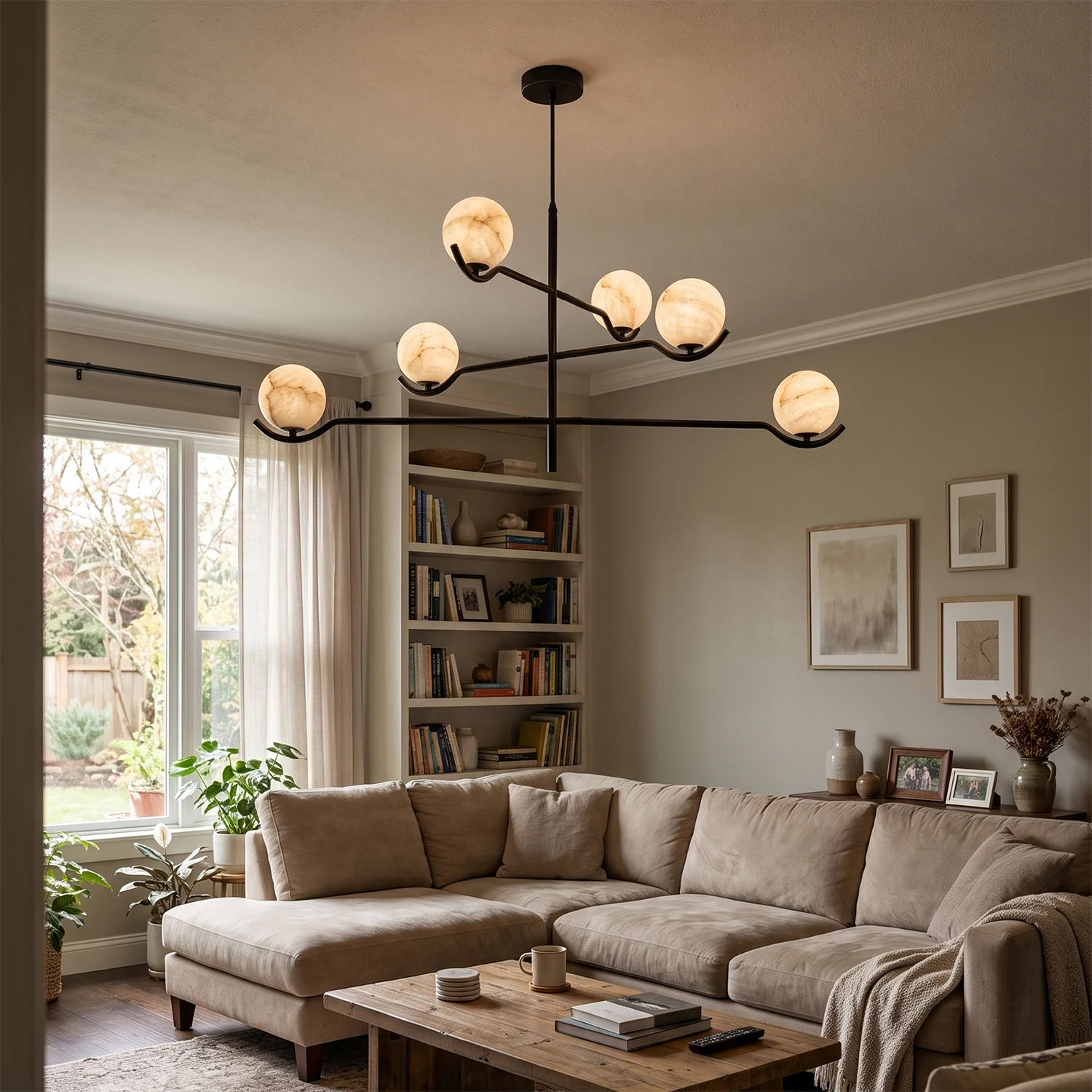
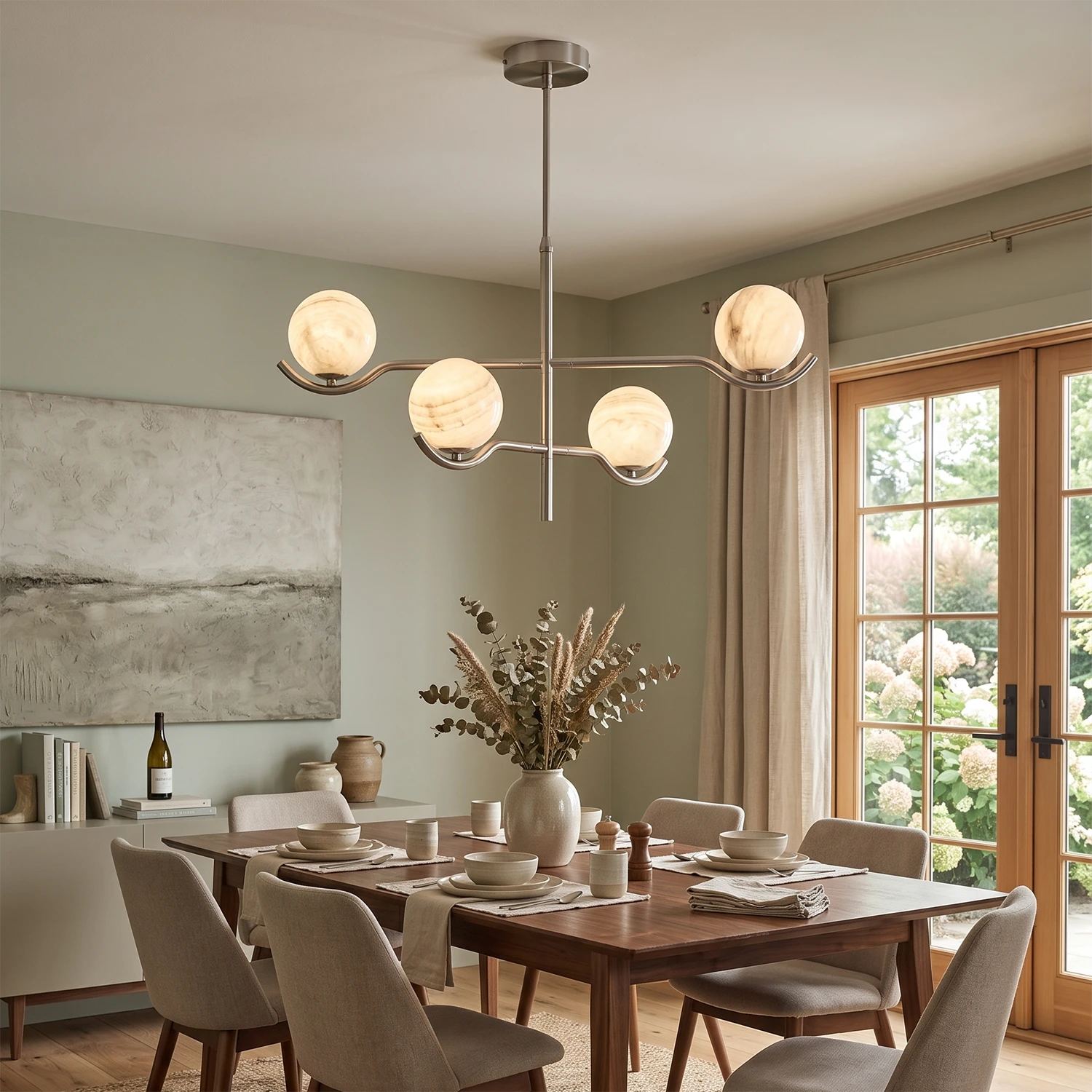
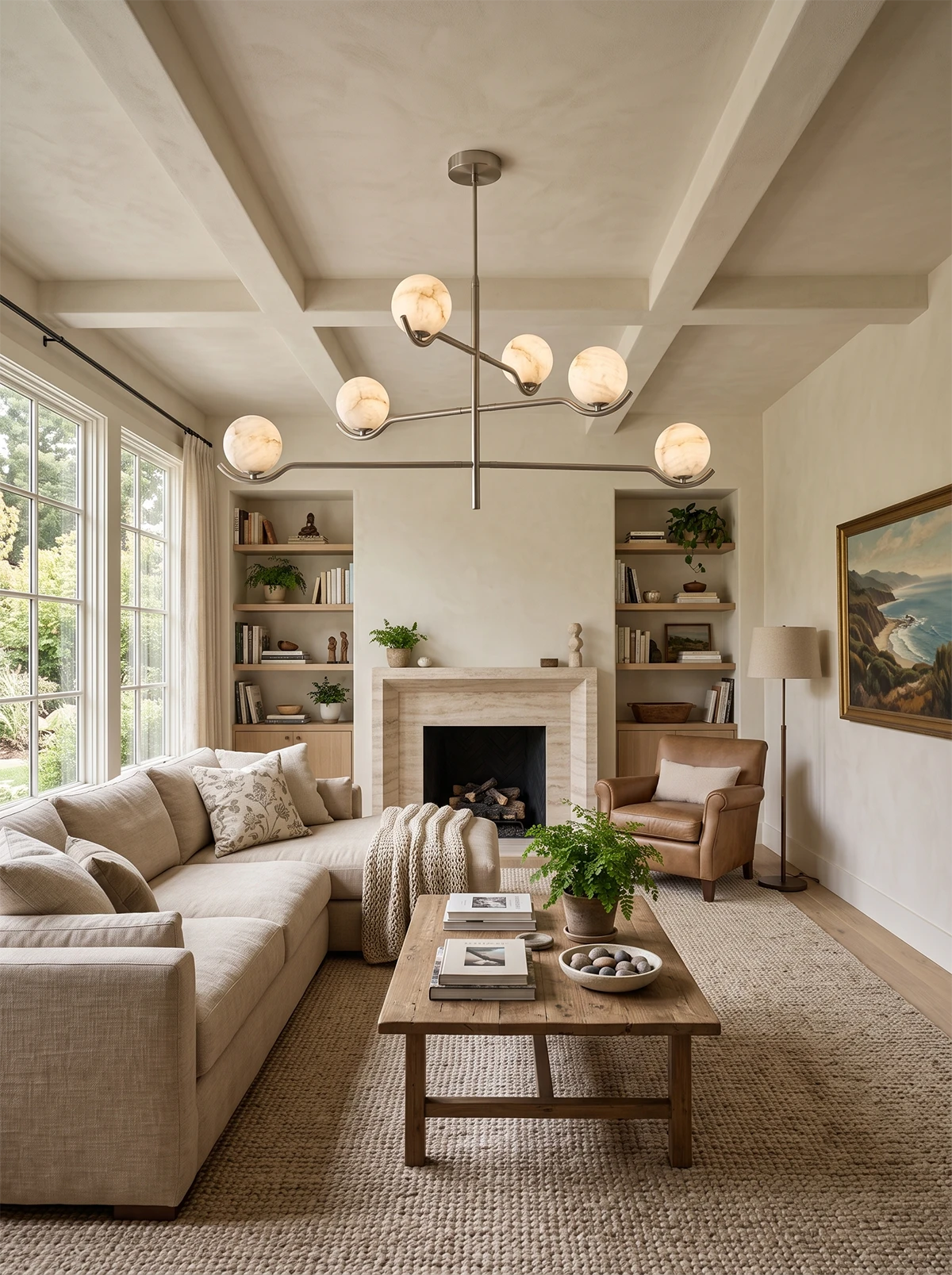
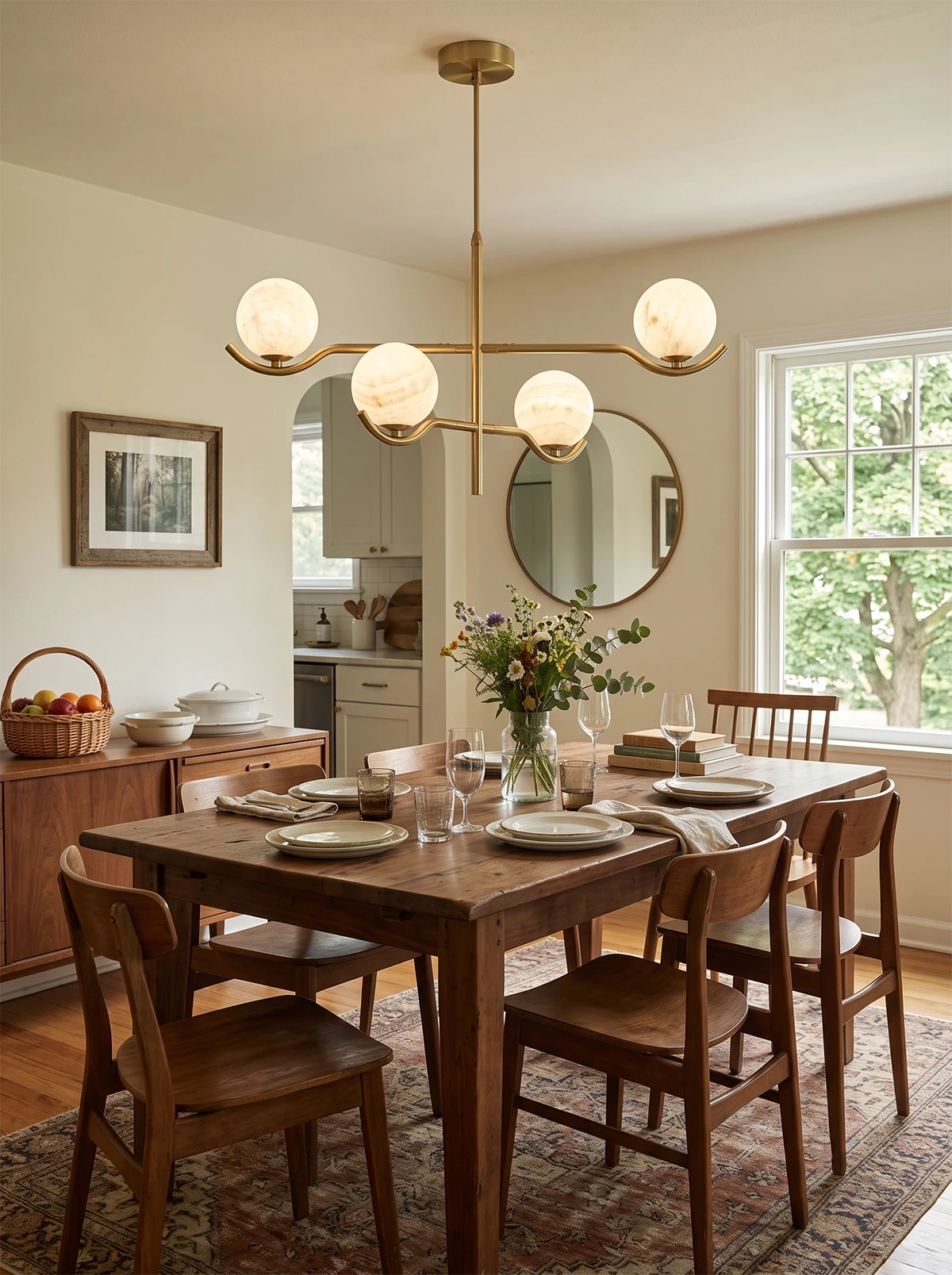
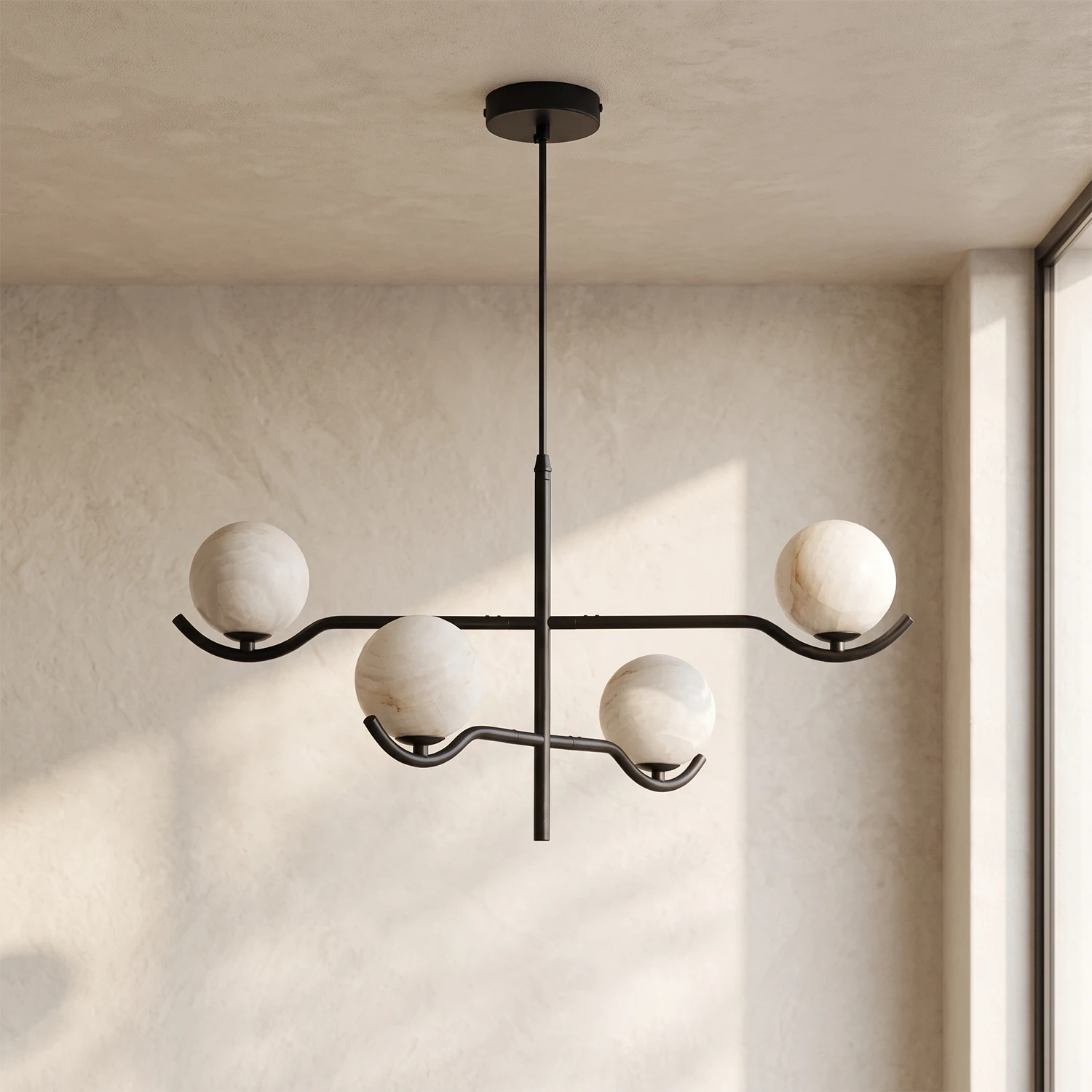
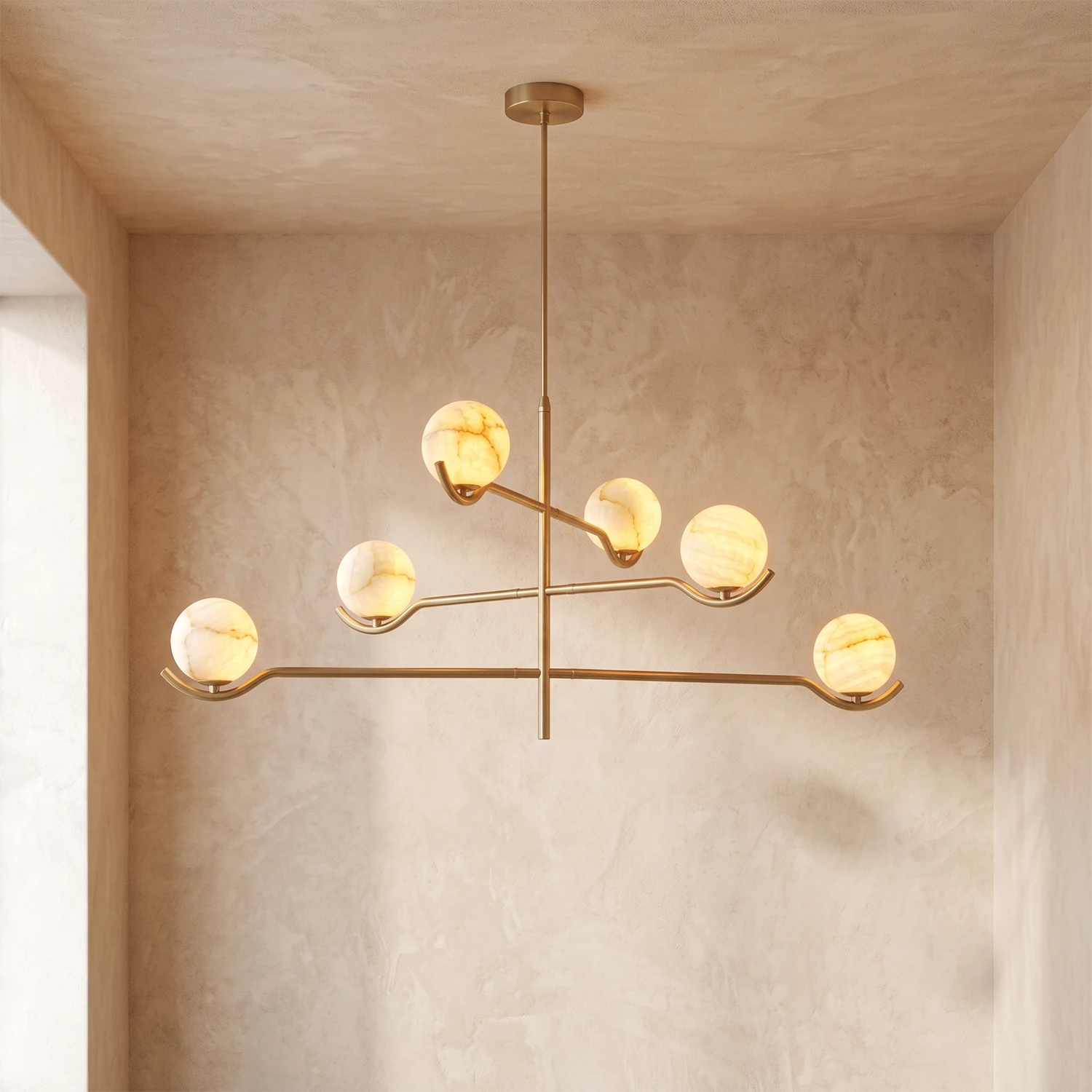
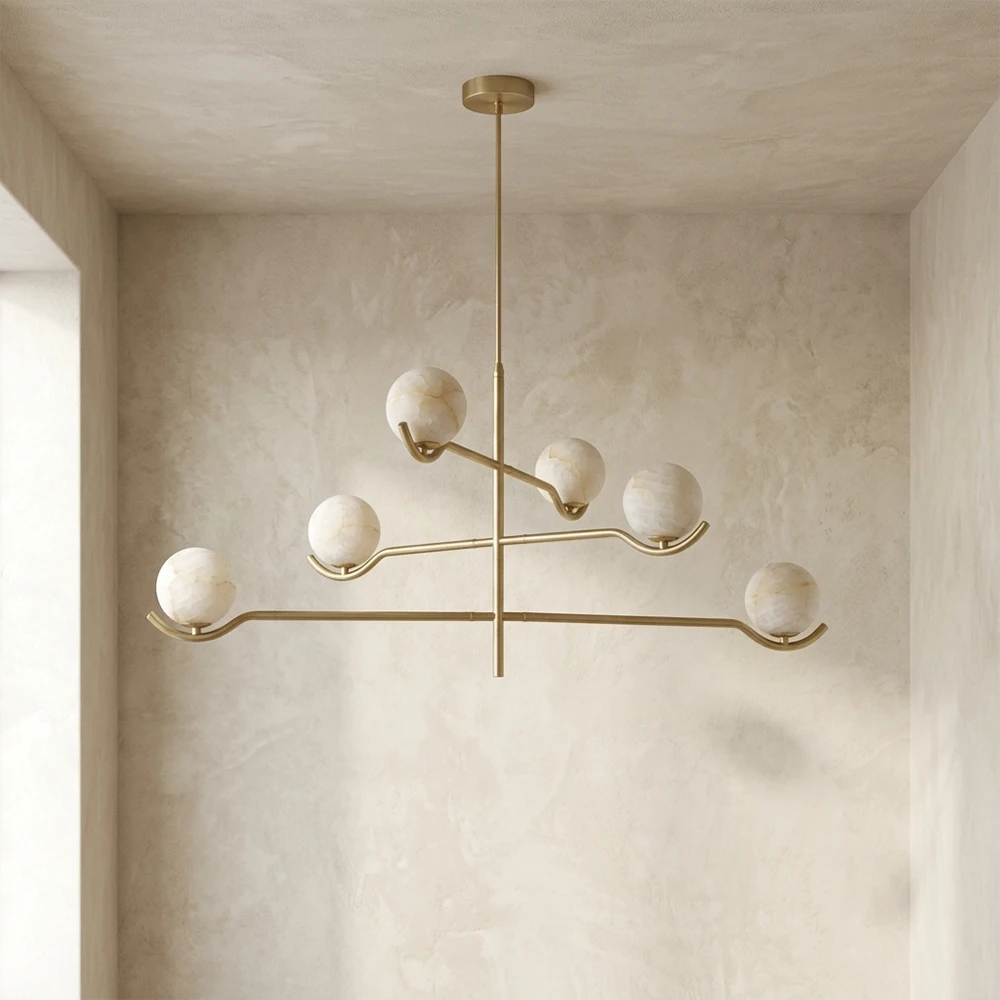
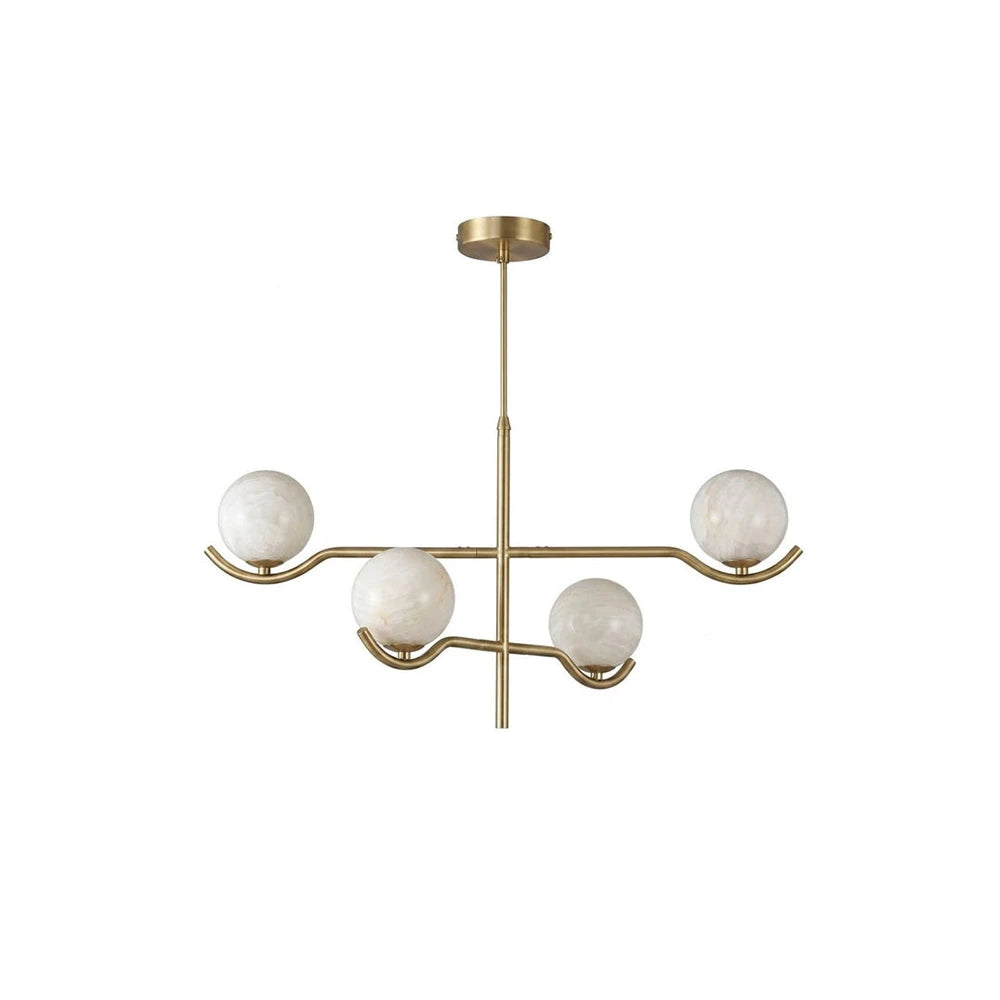
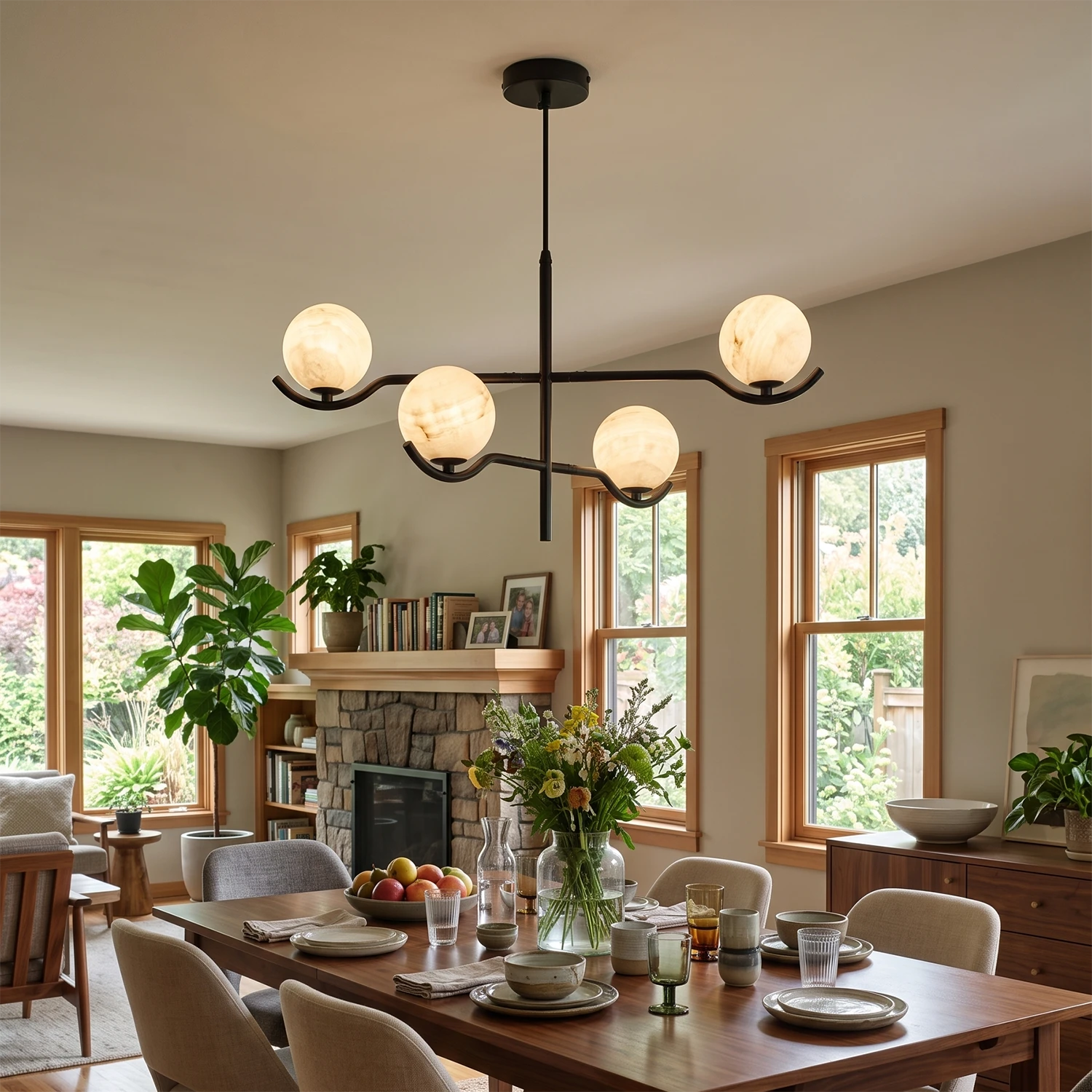
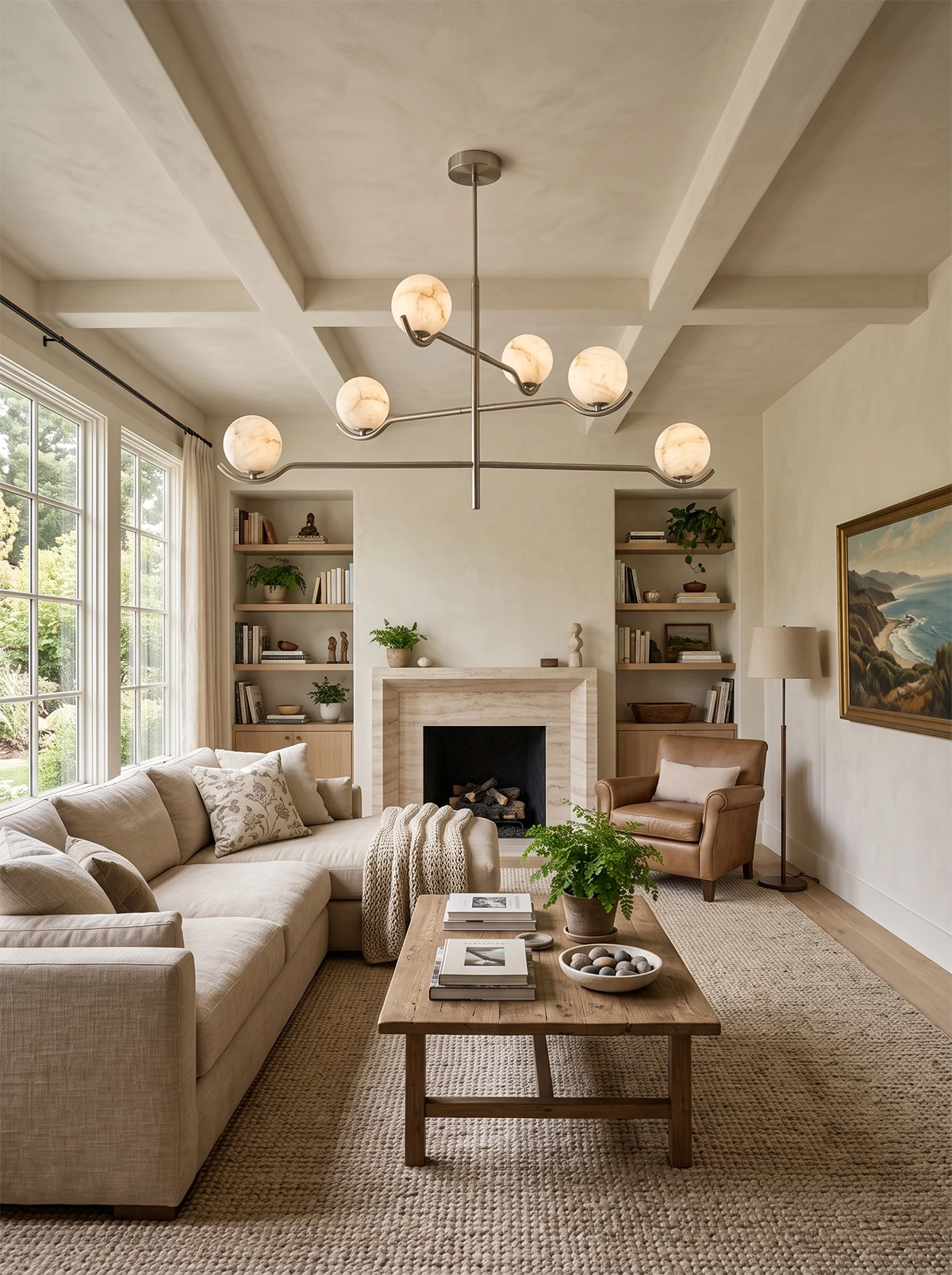
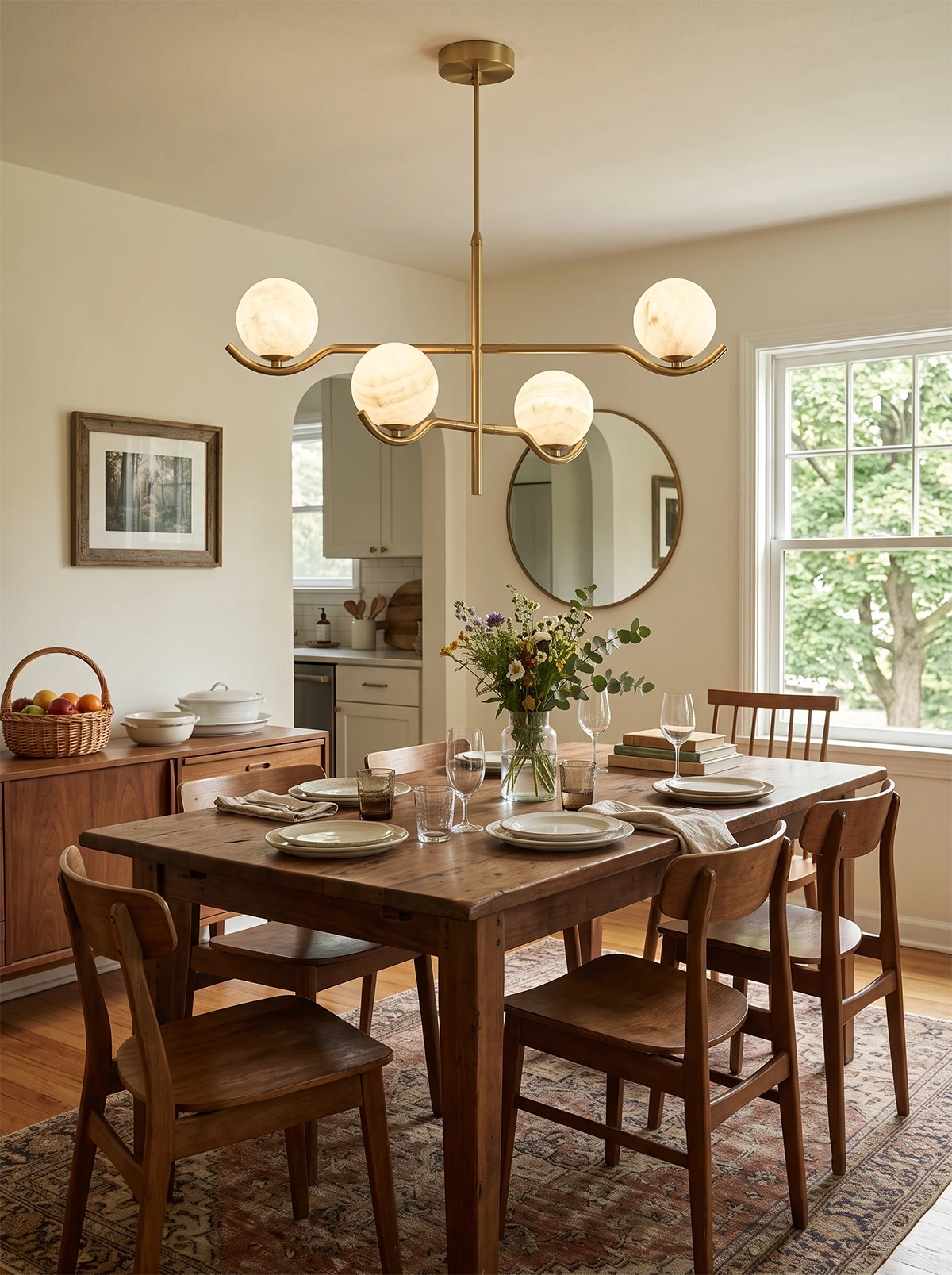
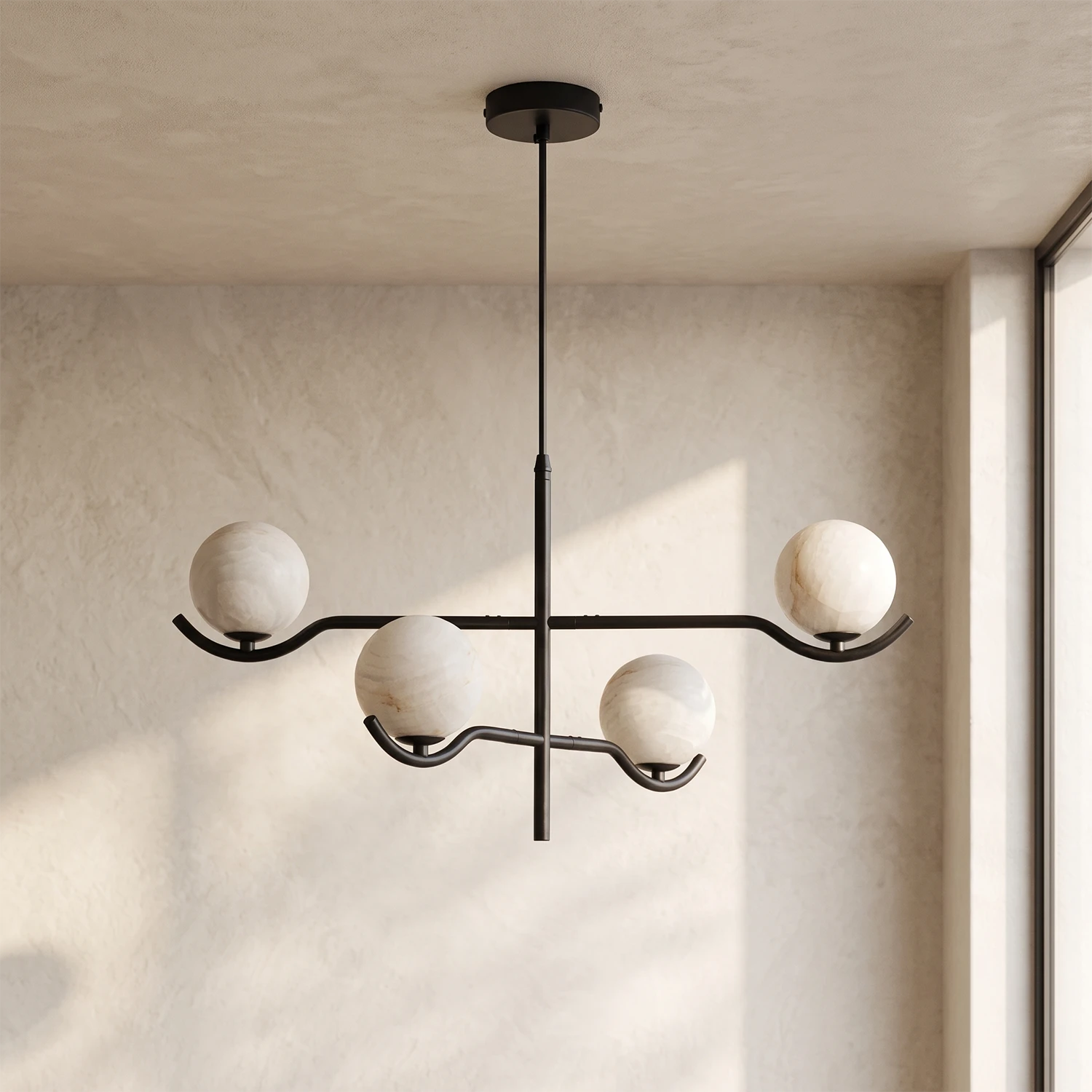
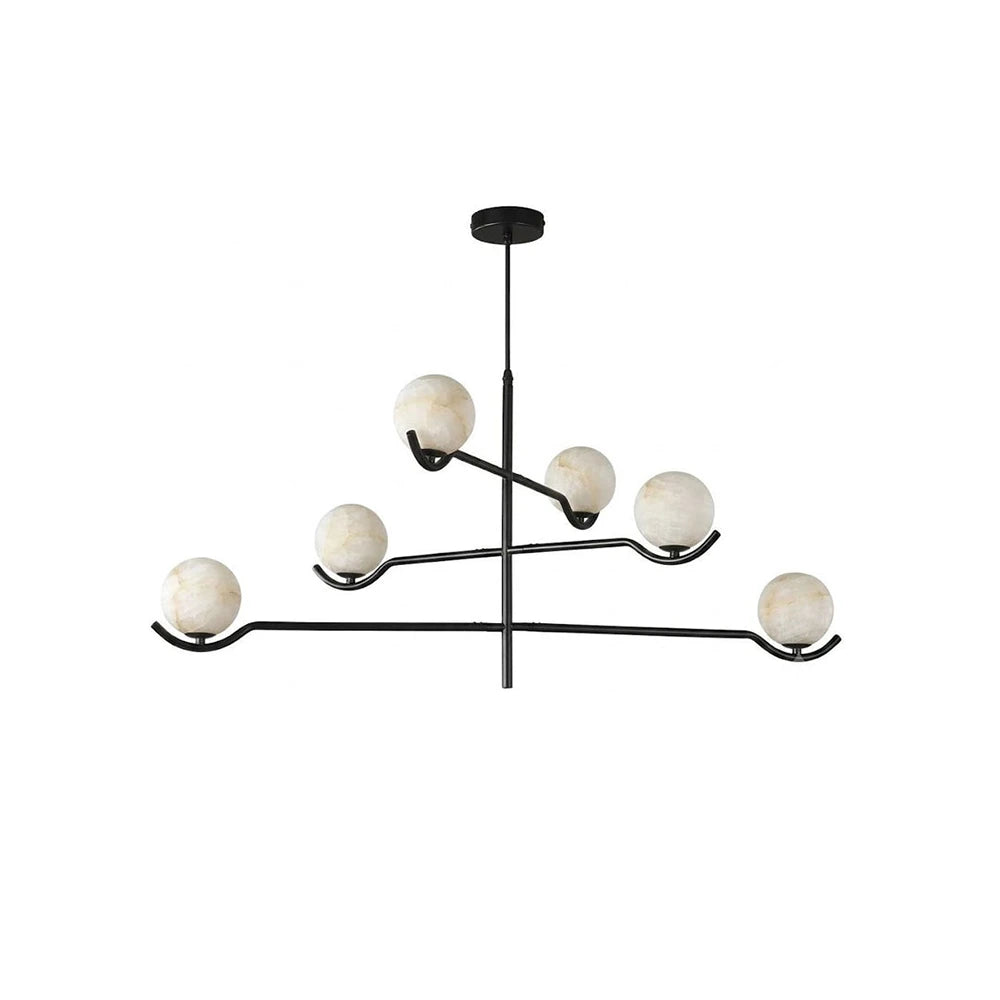
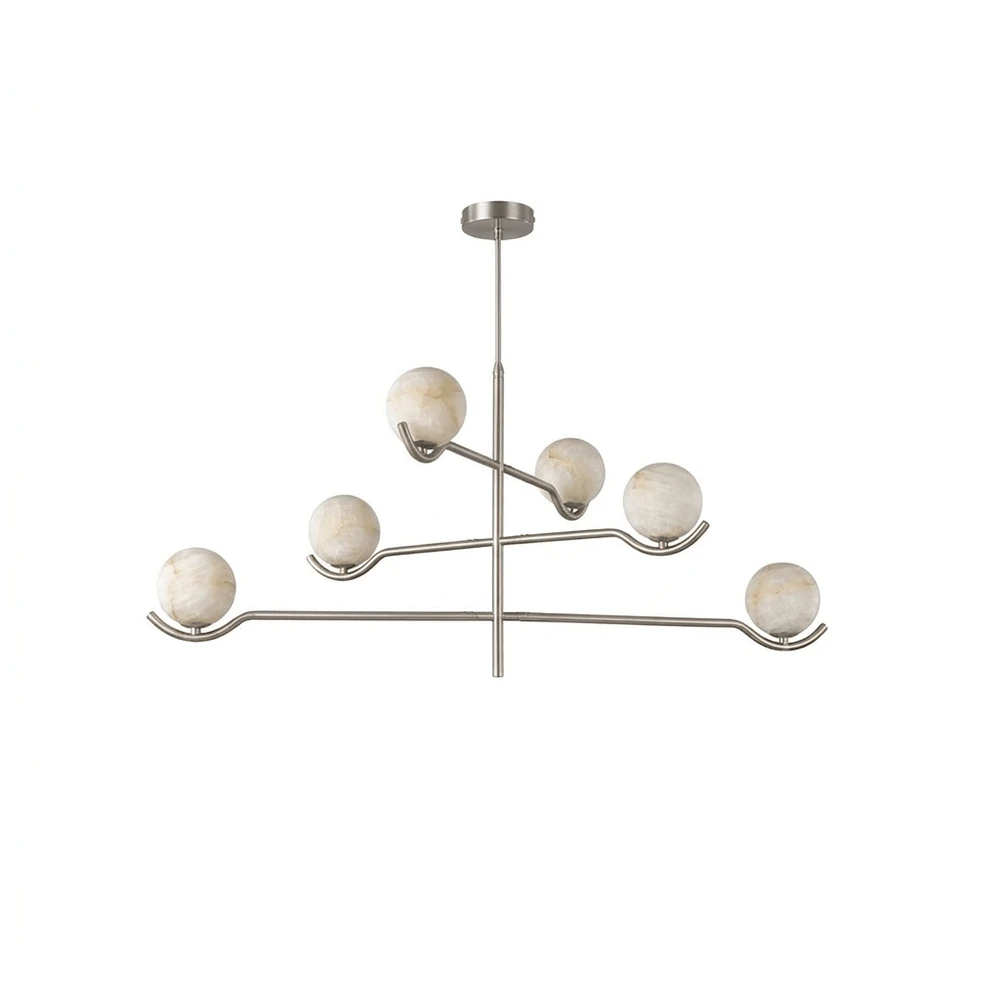

Perrin Crossing Arm Globe Chandelier

$895.00 USD
Calcola la spedizione al momento del pagamento
Size
Colour
  • Free Shipping within the US

  •  3 Years Warranty for All Lamps

  • 30-Day Return and Exchange Policy.

  • 24/7 Around-the-clock After-sales Support

  • Free returns

  • Carbon neutral

  • Secure payments

  • Bulbs Included

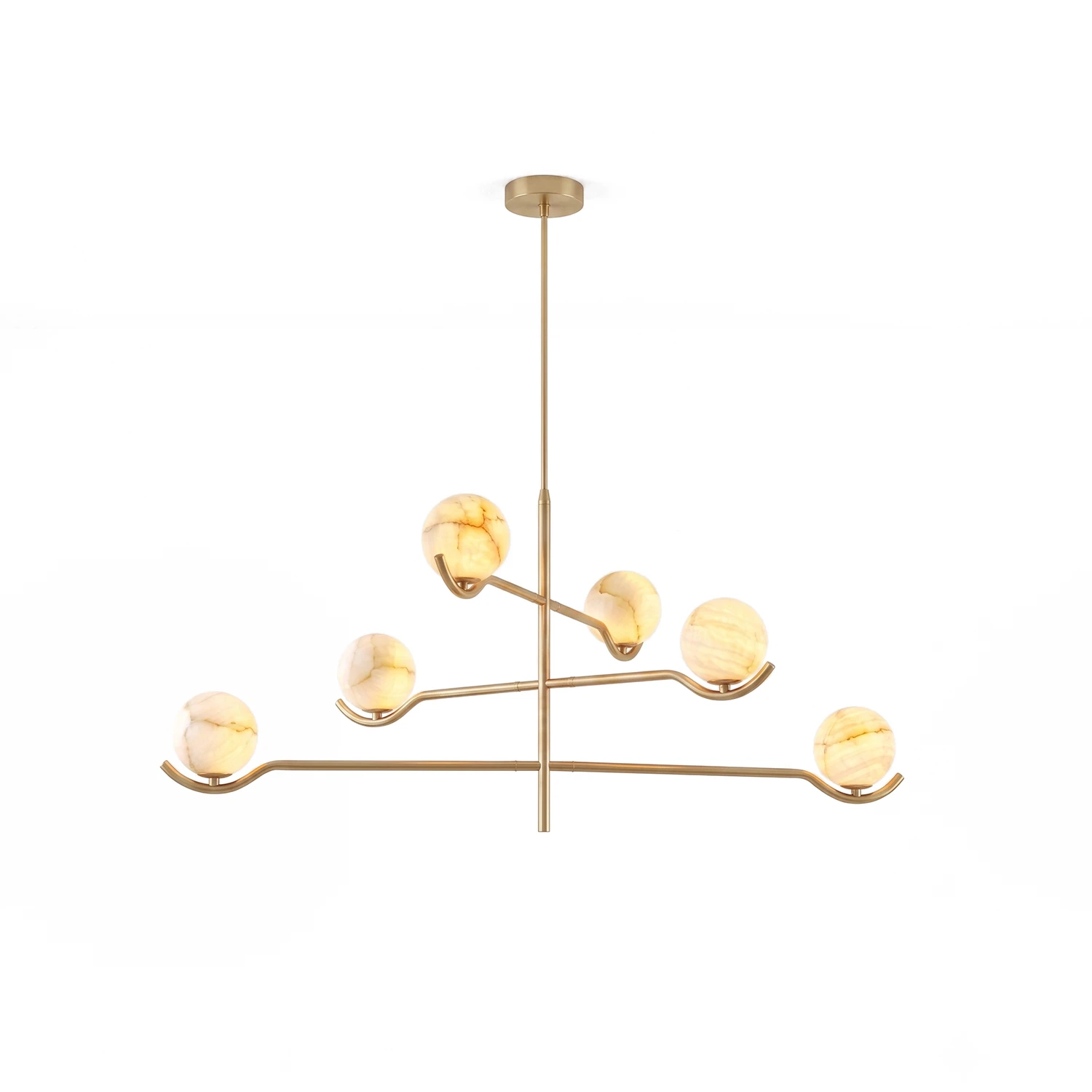
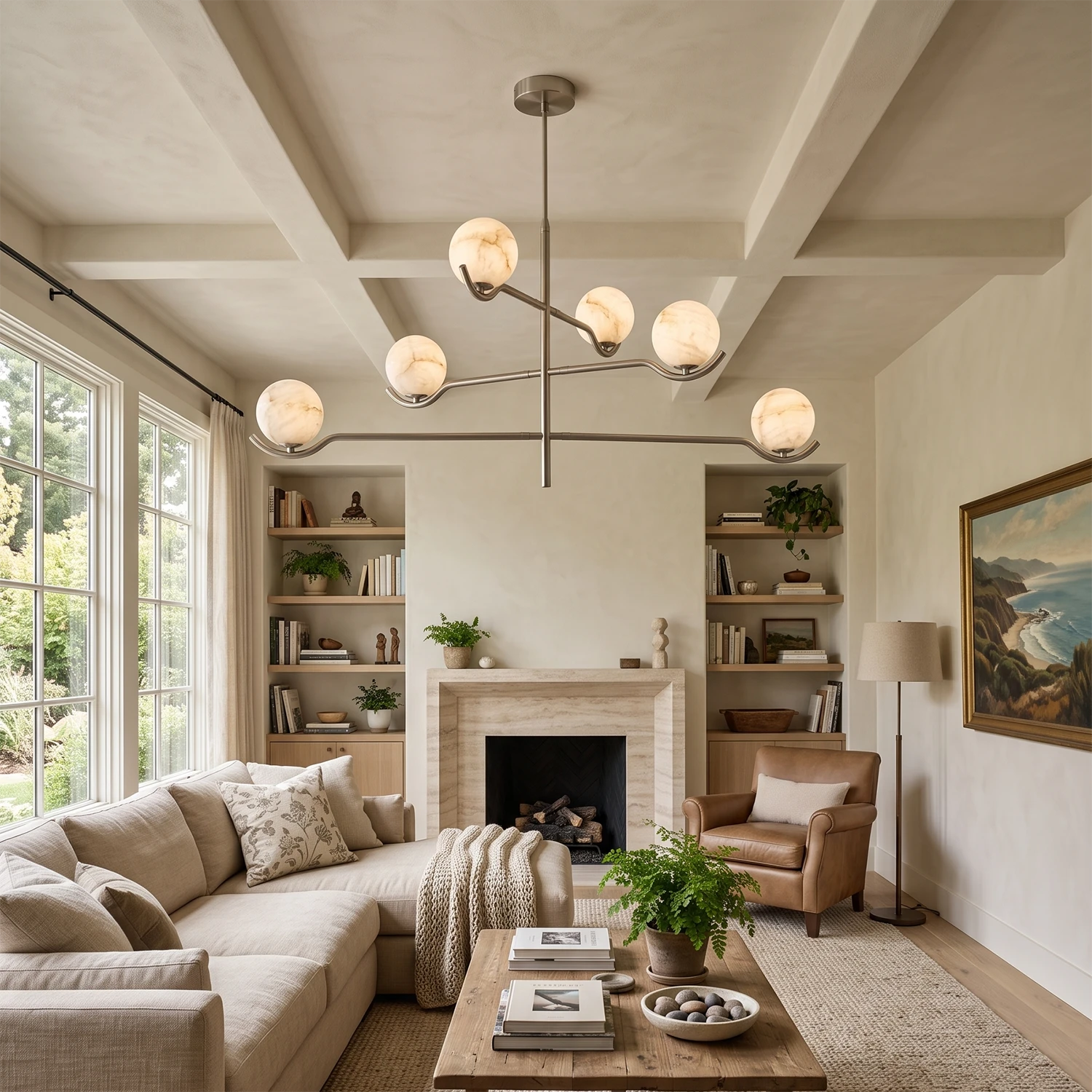
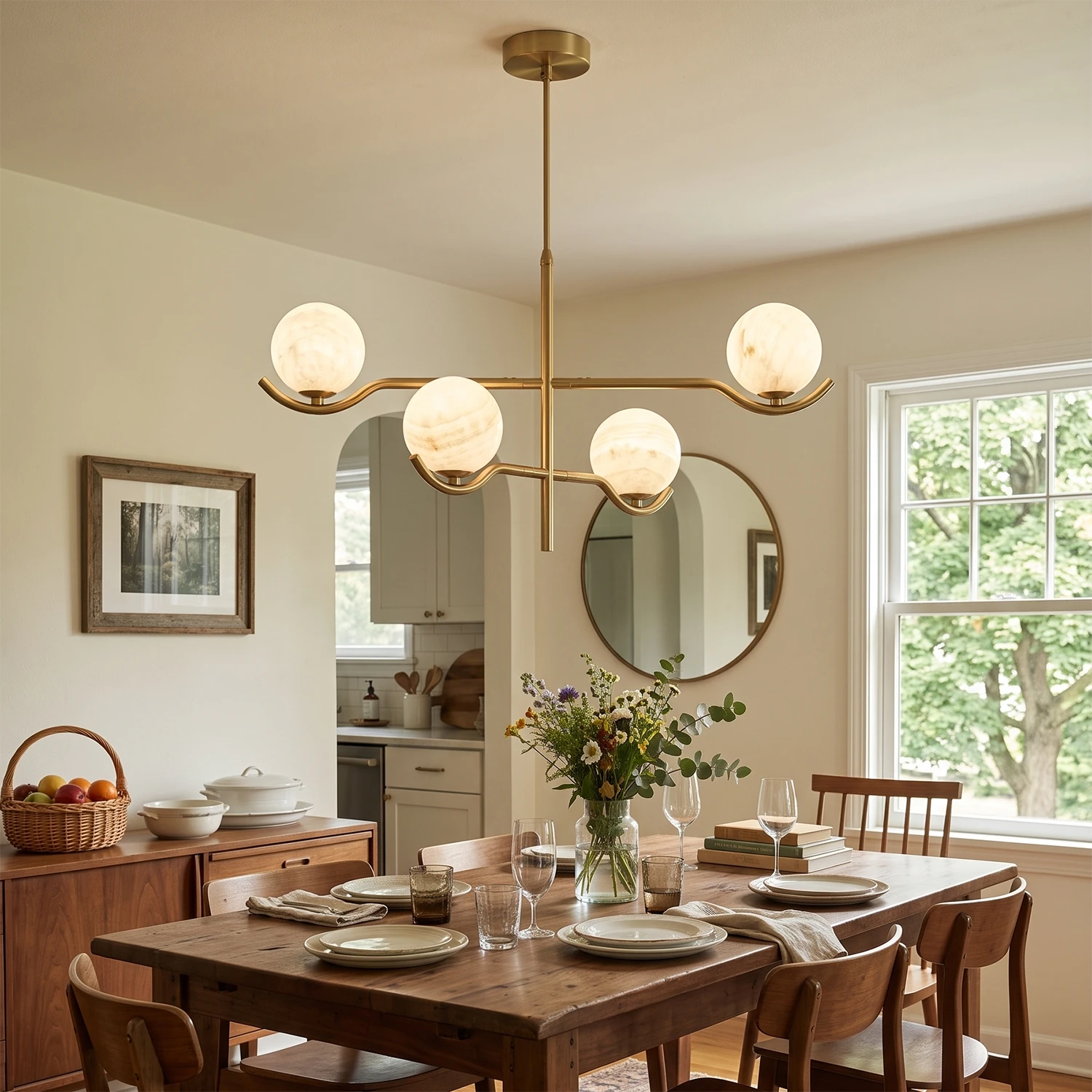
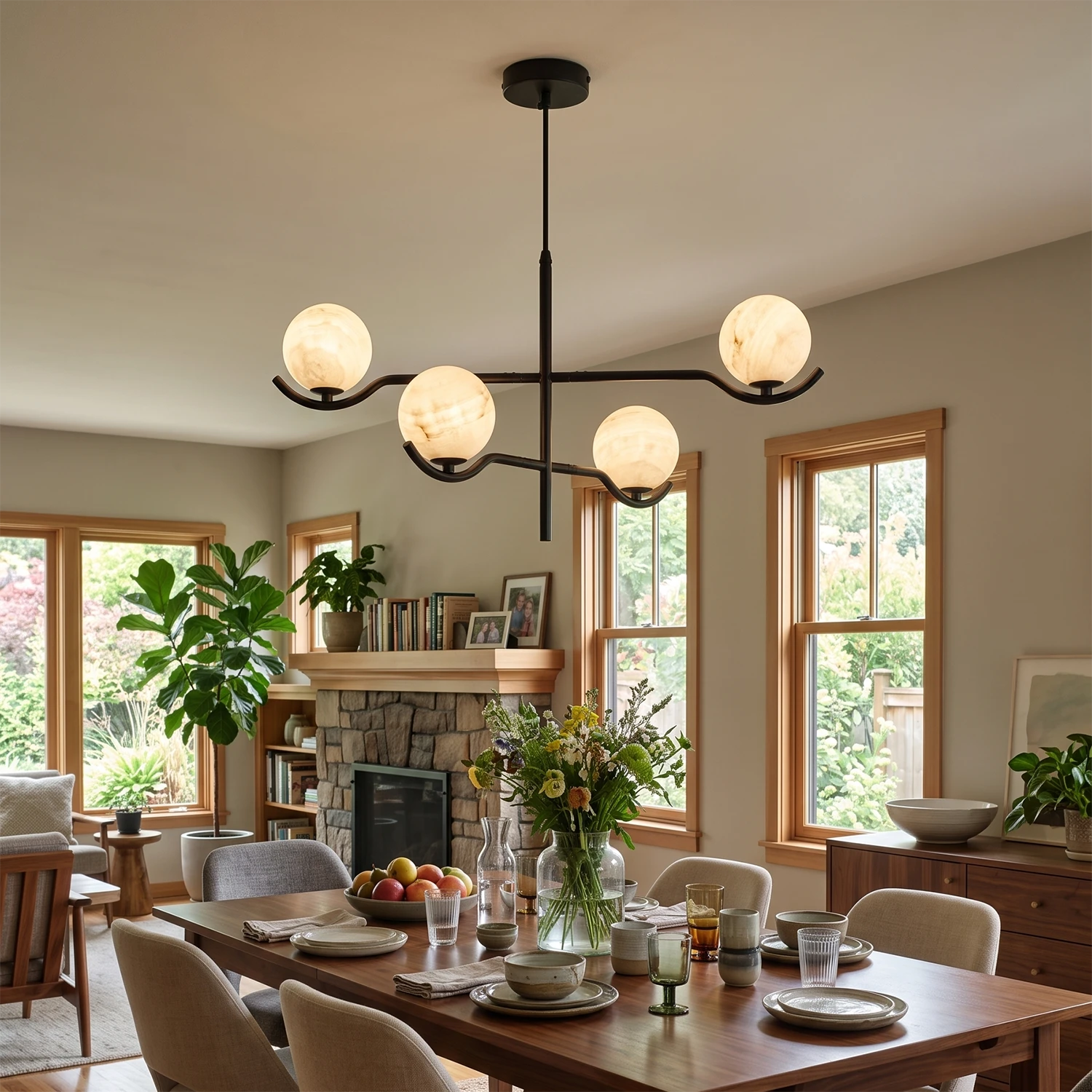
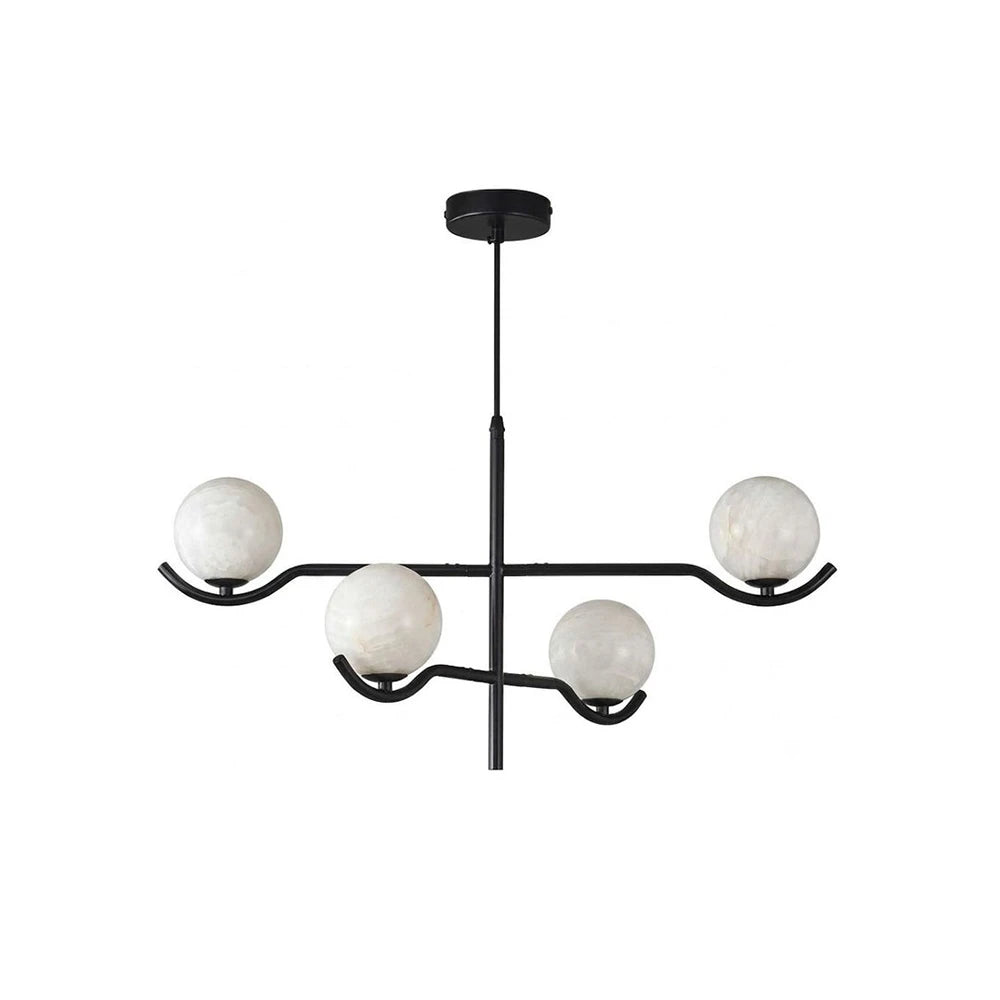
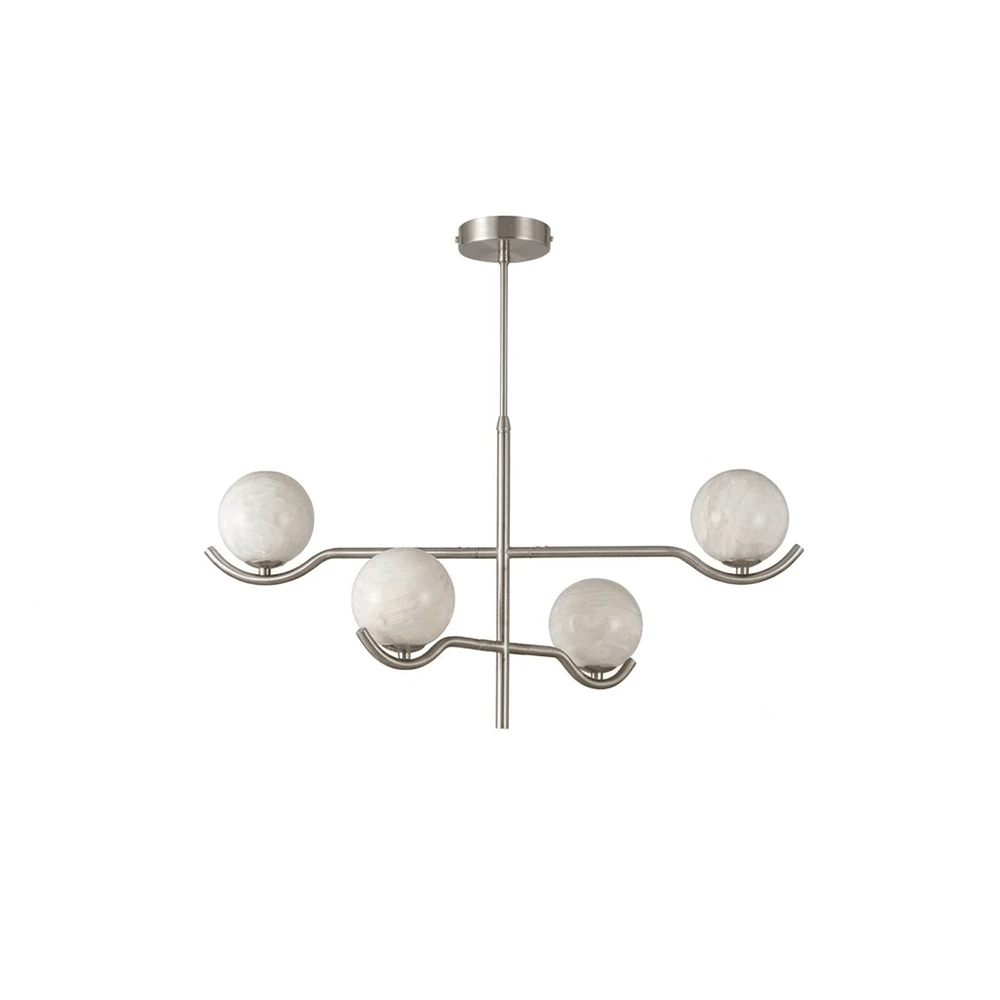
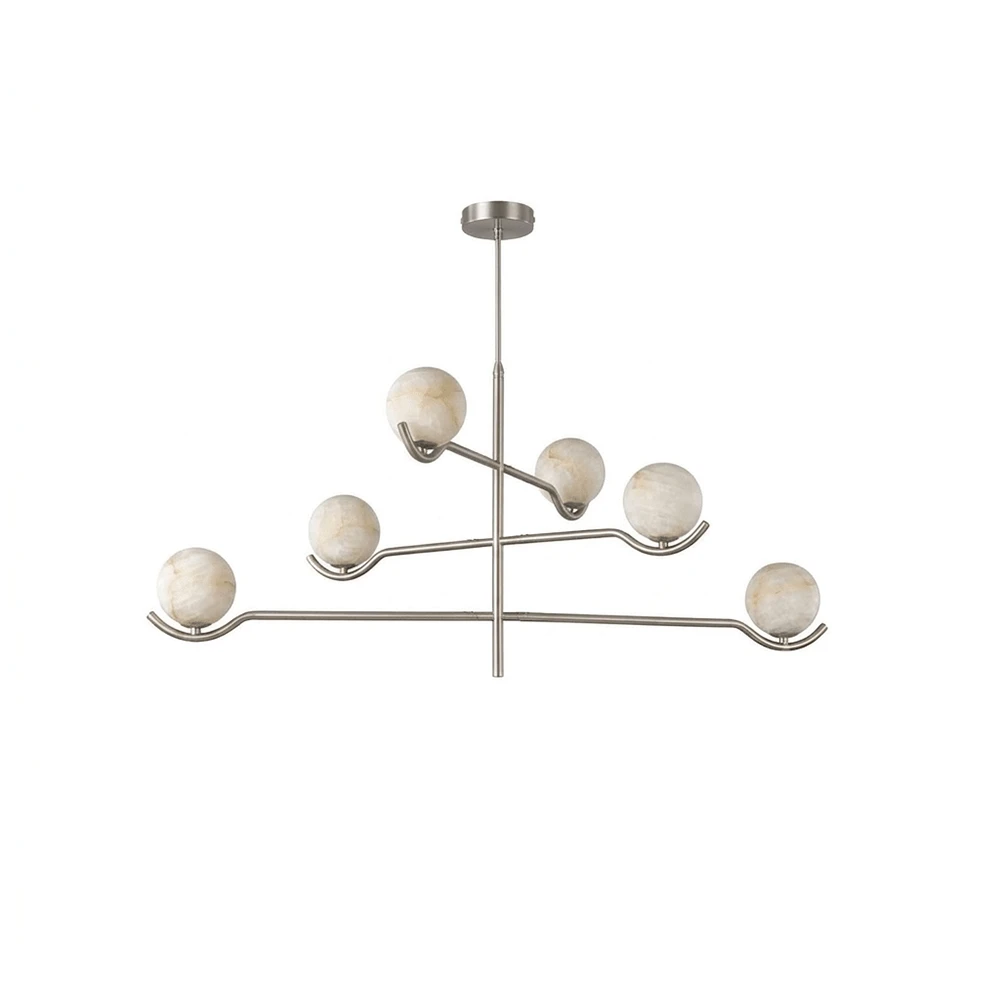
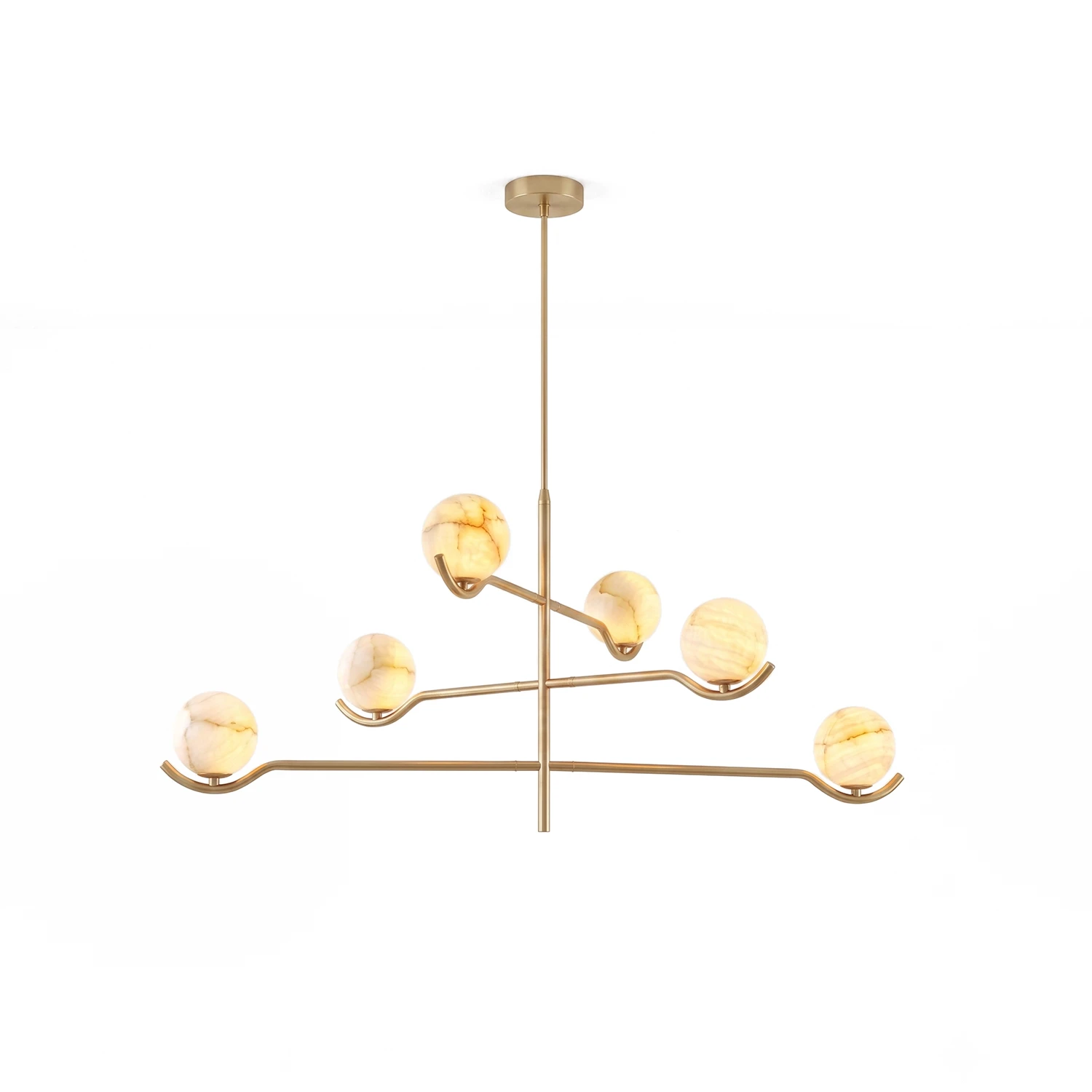
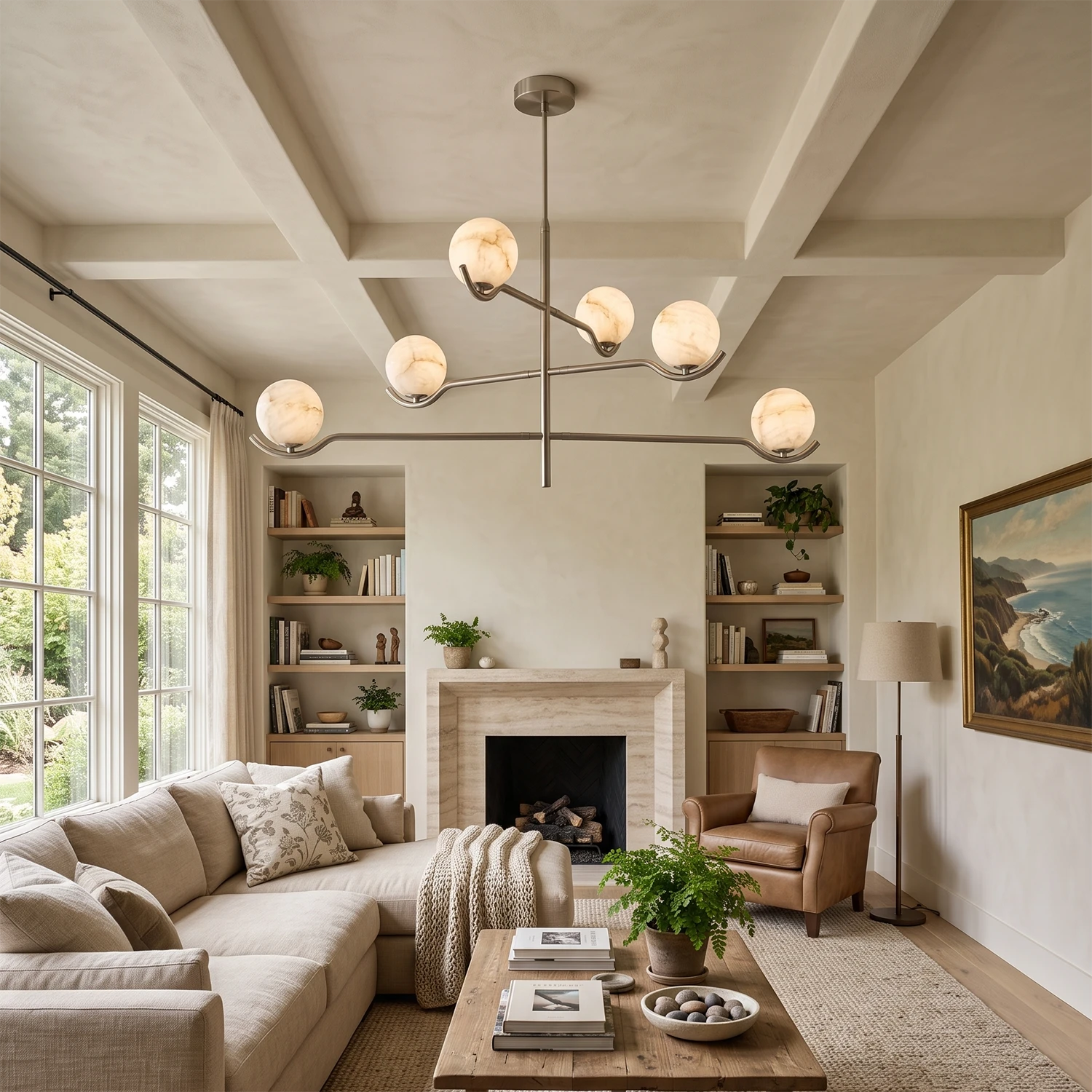
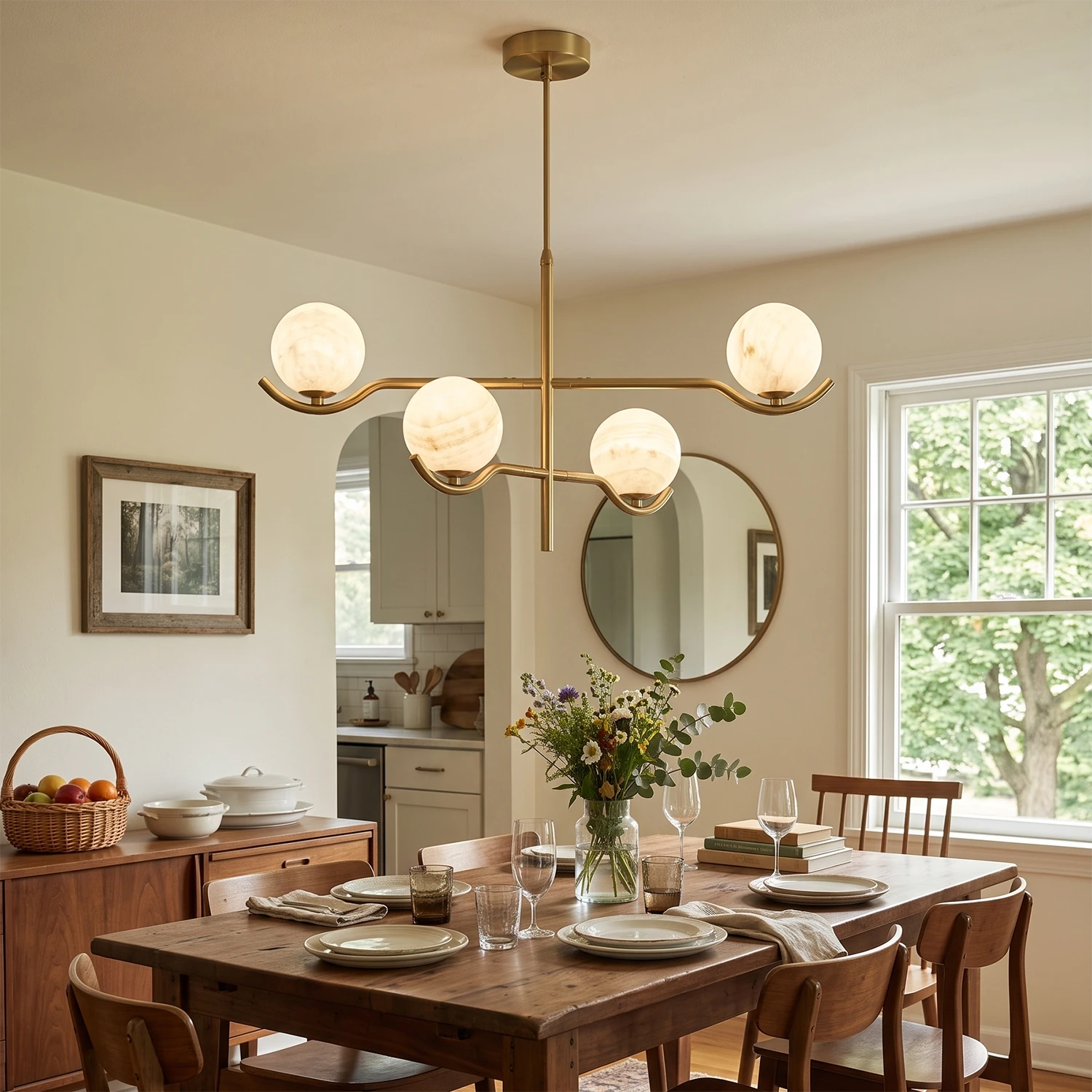
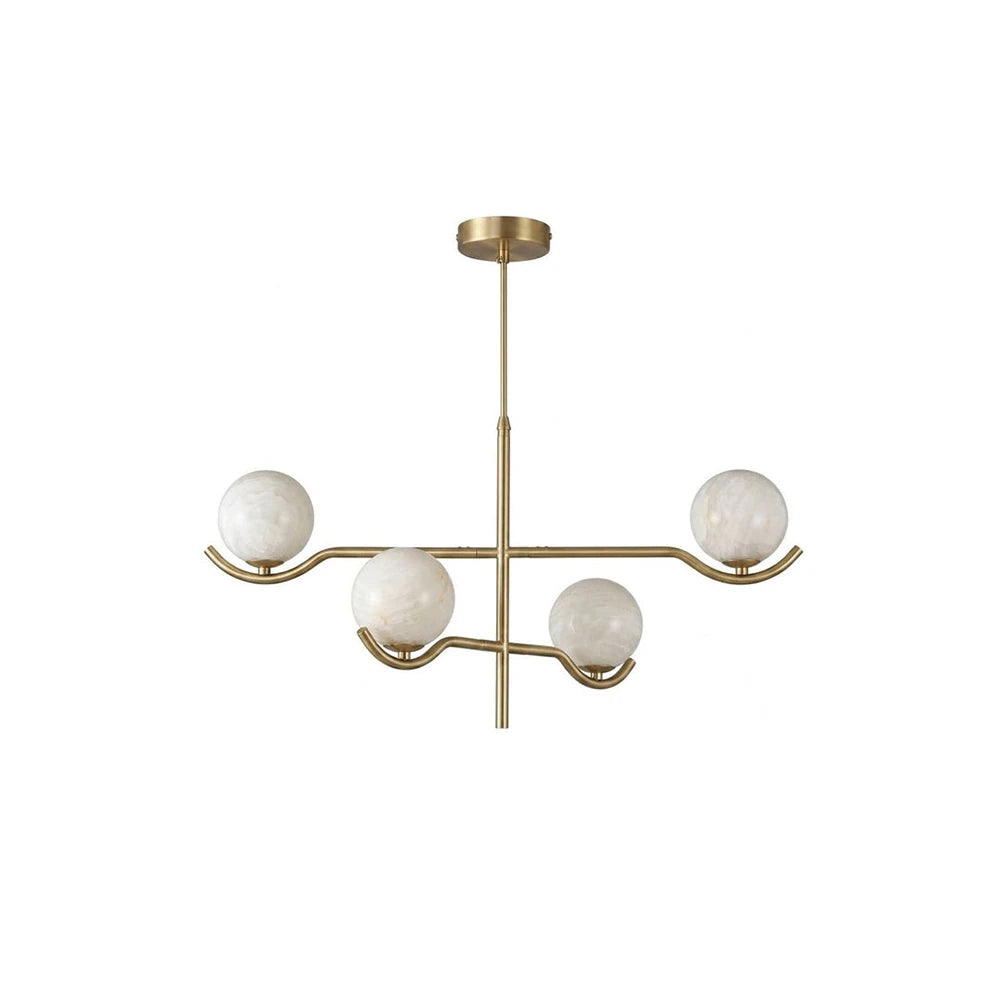
The Perrin Crossing Arm Globe Chandelier sets two horizontal arms across a slim vertical stem at different heights, each one curving down at its ends to cradle a veined alabaster globe. Nothing radiates from a centre — the arms simply cross, the way a mobile hangs in balance.

That structure is what makes it read so light for its width. A conventional chandelier gathers its mass around a hub; this one spreads it along two lines and leaves the space between them empty, so what you see from across a room is a drawing rather than an object. The globes sit at four different heights rather than in a ring, which is why the composition looks balanced instead of arranged.

The same globe appears at eye level in the Alabaster Orb Asteria Brass Wall Sconce — one stone sphere on a slim brass arm, sized for the wall rather than the ceiling.

Natural Alabaster

Naturally Unique Veining

No two pieces of stone are ever the same

Alabaster is a natural stone, so every piece carries its own veining and subtle variation in color. The fixture you receive may therefore differ slightly from the images shown.
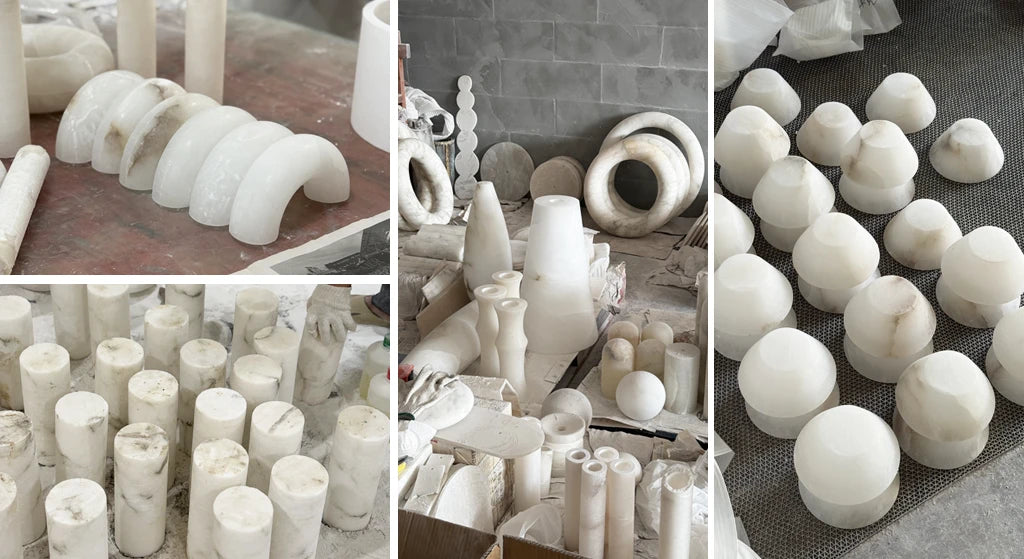
An inherent characteristic of real stone — not a quality defect.
Specifications

The Details

Material Metal Frame · Natural Alabaster Every globe is cut from real stone — no two share the same veining.
Shade White Natural Alabaster Light enters the stone rather than passing through it, so each globe glows from within with no visible bulb.
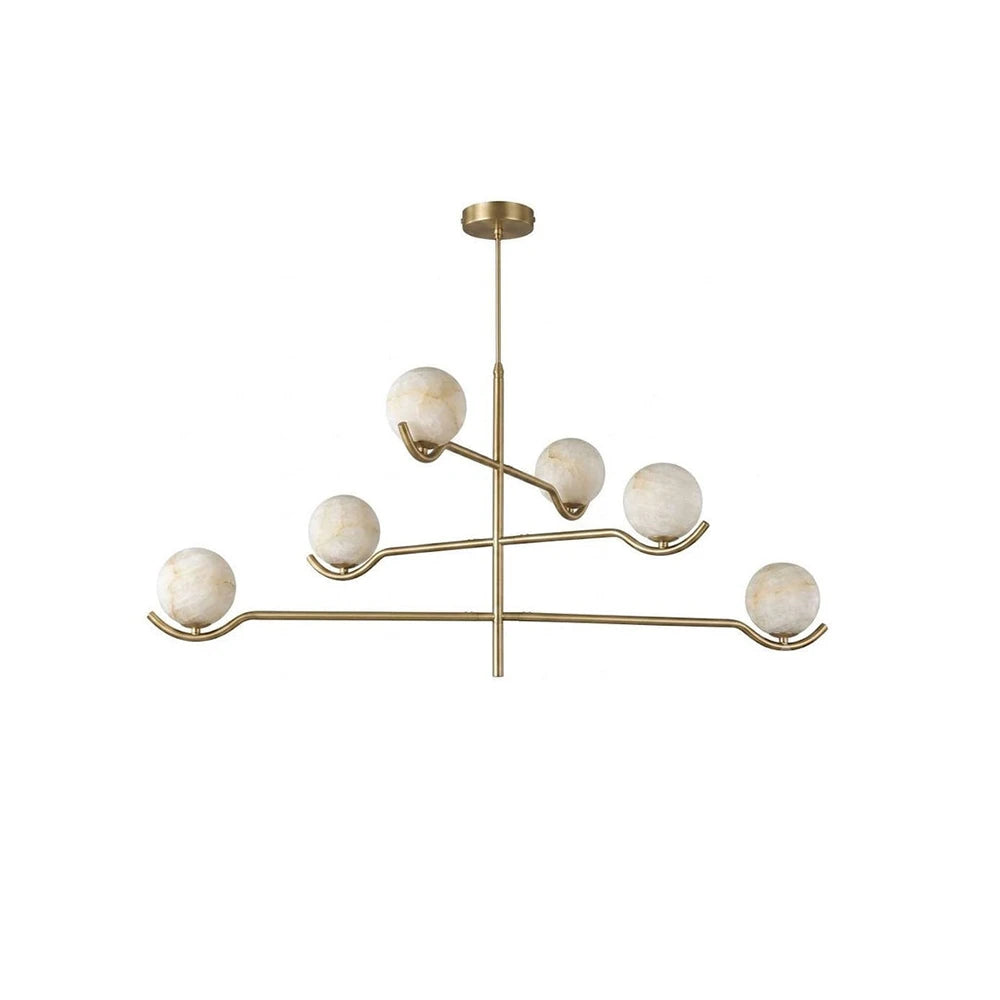
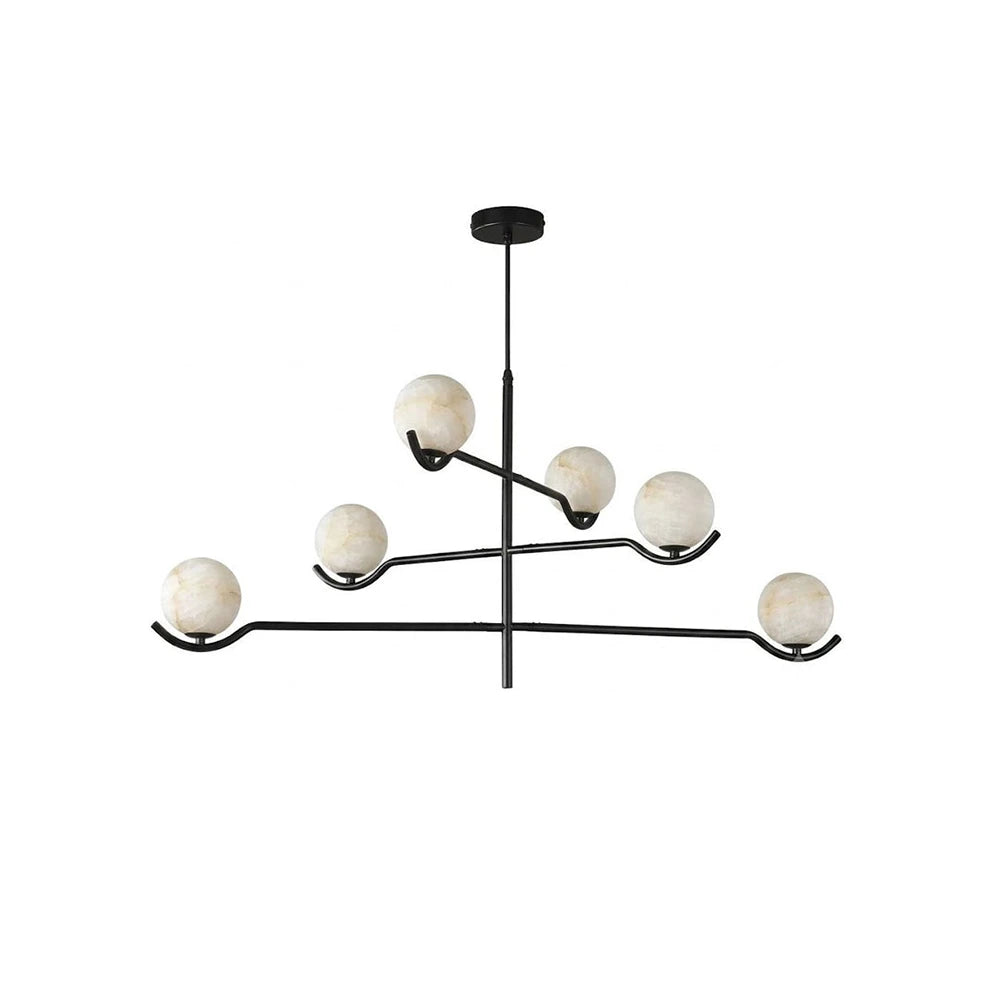
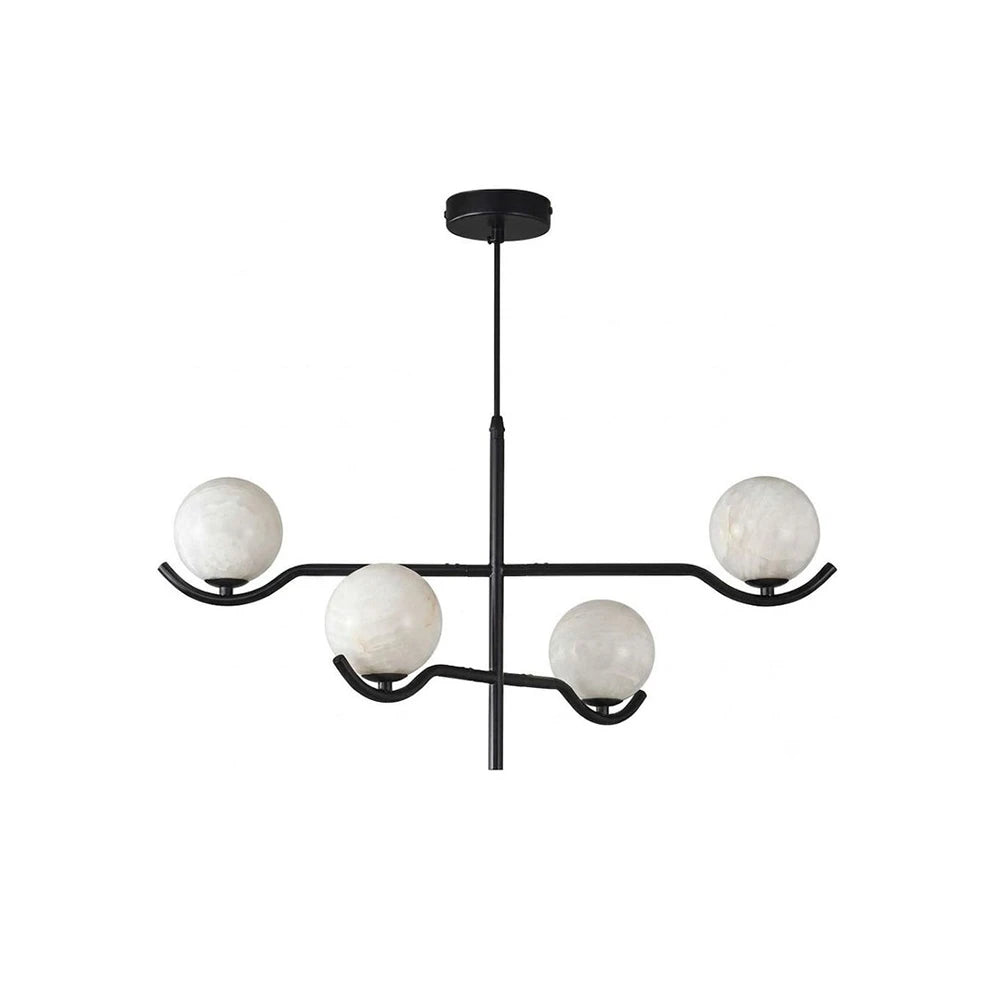
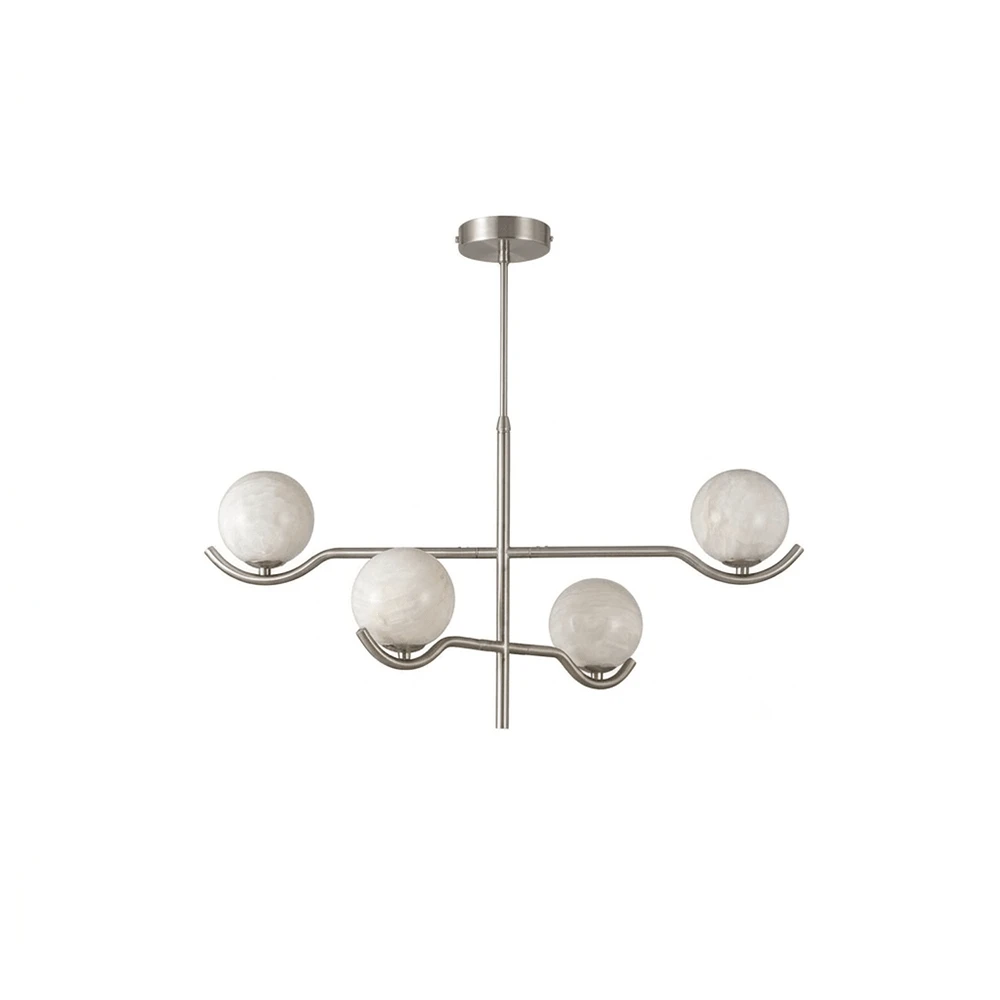
Body finish Brass Black Nickel Brass warms the stone and leans classical; black turns the arms into graphic lines; nickel keeps both cool and quiet.
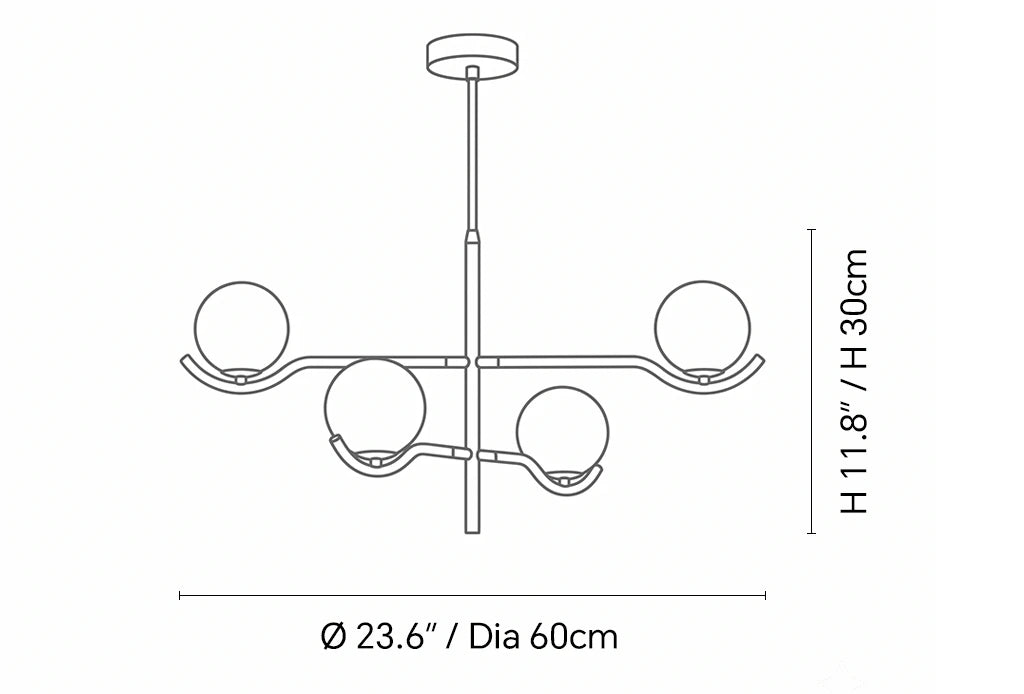
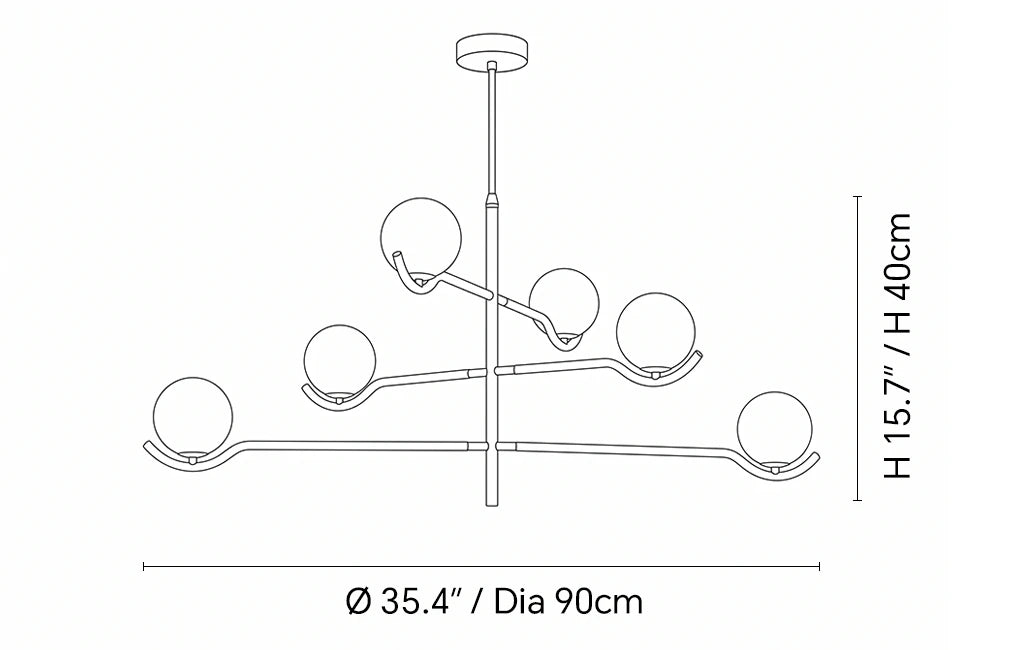
Dimensions 4 heads∅ 23.6″ × H 11.8″ · ∅ 60 × H 30 cm 6 heads∅ 35.4″ × H 15.7″ · ∅ 90 × H 40 cm Excluding the suspension cable.
Light source G4 LED bulb Warm white recommended — cooler light drains the honey tones out of the stone.
Bulbs 4 or 6 × G4 Bulbs not included. See the note below before buying replacements.
Voltage AC 110–240V
Switch Hardwired — controlled by a wall switch Dimmable when fitted with dimmable G4 LEDs on a compatible dimmer circuit.
Mounting Ceiling — hardwired Mounts to a standard junction box. Professional installation recommended.
Hanging height 59″ / 150 cm adjustable Cable shortened on site to suit your ceiling; extra length supplied on request.
Ingress rating IP20 No protection against water. Indoor, dry locations only.
Environment Indoor · dry locations
Preparation time 5–10 days Made and inspected at our own workshop before dispatch.

Good to Know

Four heads or six?

The 4-head at ∅ 23.6″ suits a round table around 31–35″ across, or a room of roughly 11 × 13 ft. The 6-head at ∅ 35.4″ suits a round table around 47–53″, or a room of roughly 15 × 20 ft.

Both are shallow for their width — 11.8″ and 15.7″ tall — so neither eats headroom. Because the arms spread horizontally rather than gathering at a hub, going one size up costs you width but almost nothing in visual weight. Over a table, err larger.

Where it can and cannot go

Rated IP20 — protected against contact, but with no protection against water at all. It belongs in dry indoor rooms: dining rooms, living rooms, bedrooms, entries, stairwells.

Do not install it in a bathroom, above a bath or shower, in a laundry, or on a covered porch, even one that stays out of direct rain. Alabaster gives you a second reason to avoid damp rooms beyond the electrical one — humidity is not good for the stone either.

Size Guide

Four Heads or Six

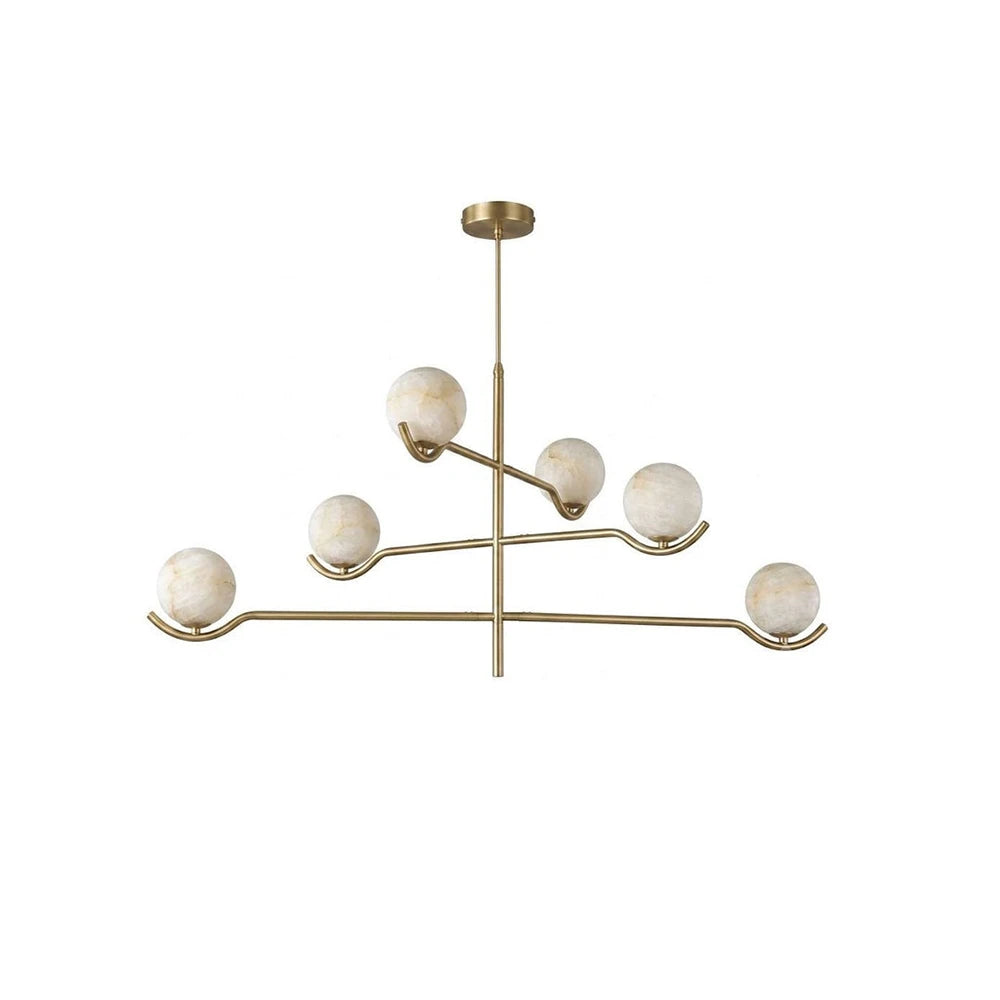
The difference is not only width. The four-head is two crossing arms on two levels; the six-head adds a third arm at a third height — so stepping up adds a tier to the composition, not just diameter.

4 HeadsPopular
Two crossing arms · two levels ∅ 23.6″ × H 11.8″ ∅ 60 × H 30 cm, excluding cable
Globes4 alabaster globes · 4 × G4
Round table31–35″ (79–89 cm) across
Ceiling8 ft and up

The quieter of the two — a clean cross that reads as a line rather than a cluster.
6 Heads
Three arms · three levels ∅ 35.4″ × H 15.7″ ∅ 90 × H 40 cm, excluding cable
Globes6 alabaster globes · 6 × G4
Round table47–53″ (119–135 cm) across
Ceiling9 ft and up

The third arm turns a cross into a composition — more depth from underneath, and half again the light.
BrassWarms the stone and leans classical. Best with oak, cream, plaster and warm-toned rooms.
BlackTurns the arms into graphic lines and pushes the piece modern. Strongest against a pale wall.
NickelKeeps both metal and stone cool and quiet — the one that disappears and lets the globes do the work.

Sizing Tip

Over a round table, take two thirds to three quarters of the table diameter — which puts the four-head over a table of 31–35 in and the six-head over one of 47–53 in. In an open room instead, add the length and width in feet and read the sum as inches: roughly 11 × 13 ft for the four-head, 15 × 20 ft for the six.

Then note what this shape does that most chandeliers don't. Both versions are shallow for their width — 11.8 in and 15.7 in tall — because the arms spread sideways rather than gathering at a hub. So going up a size costs you width and almost nothing in headroom, which is the opposite of how a tiered chandelier behaves. Over a table, err larger.

Height is set on site: the 59 in cable shortens during installation and can be extended before dispatch if you tell us your ceiling height when ordering. Hang the lowest globe 30–36 in above a tabletop, and keep 7 ft of floor clearance anywhere people walk.

The design

A Chandelier With No Centre

The arms cross. The middle stays empty. That is the whole idea.

Almost every chandelier ever made is built around a hub. Arms radiate outward, the mass gathers in the middle, and the middle is the part you look at. This one has no hub at all. Two horizontal bars pass through a vertical stem at different heights and simply keep going — and the centre of the fixture, where a chandelier normally holds everything, is empty air.

The consequence is the reason to own it. Because the weight sits at the ends and nothing accumulates in the middle, you can see straight through it. Across a dining table that matters more than it sounds — you see the person opposite rather than a mass of glass between you. From the doorway it reads as a line drawing rather than an object, which is how a fixture nearly a metre wide can hang in a room without dominating it.

— Nothing in the middle. Everything in balance. —
Materials

Why Real Alabaster

Alabaster-look glass and resin are everywhere in lighting, and they photograph well. Here is what changes once the piece is in the room — including the one thing they do better.

Natural Alabaster Alabaster-Look Glass / Resin
The light Light enters the stone and comes back out softened — the globe glows from within, with no visible bulb and no hotspot Light passes through a thin shell; the bulb often shows as a bright spot or a shadow through the surface
The veining Veins run through the thickness of the stone, so they change as the light moves and the globe is different on every side Pattern printed or moulded onto the surface — flat, and the same motif recurs every few pieces
Switched off Reads as pale marble against the ceiling, with real depth and weight in daylight Reads as plastic the moment the light is off, however convincing it looks lit
In the hand Cool, dense and unmistakably heavy — a stone globe weighs what a stone globe weighs Warm to the touch and light enough to lift with two fingers
The cut edge Where the globe meets its fitting you see a cut stone edge, and the veining carries straight through it The pattern stops at the seam, because there is nothing underneath it
Care Dust only. Alabaster is a gypsum stone and slowly soluble in water — a damp cloth will dull it over time. Imitation is genuinely easier here Wipes clean with a damp cloth and shrugs off household sprays. Lower maintenance, and worth saying so

Questions, Answered

Common Questions

Is it real alabaster, and how would I know?

Yes — every globe is cut from natural stone. Three things tell you, and they are worth knowing whoever you eventually buy from.

Weight. A stone globe is heavy and cool to the touch; a moulded one feels warm and light. The cut edge. Where the globe meets its fitting you can see a cut stone edge with the veining running straight through it — on a printed imitation the pattern stops at the seam. The veining under light. Real veins sit inside the thickness of the stone, so they shift as your eye moves and the globe looks different from each side. A printed pattern stays flat and repeats from piece to piece.

Will the globes match each other?
They are matched by hand within each fixture so that they read as a family — similar tone, similar density of veining, nothing that jumps out. But they are never identical, because each one is cut from a different part of a different block. Some come out pale and almost cloudless; others carry warm honey lines. That variation is the argument for stone over moulded glass, not a compromise on it.
How do I clean it?

Dust only — never use water on the stone. Alabaster is a gypsum mineral and is slowly soluble in water, so a damp cloth used regularly will dull the surface and eventually etch it. Use a soft dry cloth or a dry brush on the globes, and keep solvents, glass sprays and all-purpose cleaners well away.

The metal arms can take a barely damp cloth as long as you keep it off the stone. Switch off and let the bulbs cool completely first.

How bright is it?

Plan it as the warm ambient layer rather than the only light in the room. Stone absorbs more light than opal glass does — that absorption is exactly what produces the soft internal glow — so four or six globes give a gentle, even wash rather than a bright one.

Over a dining table or in a bedroom it carries the room comfortably. In a kitchen or anywhere you need to see detail, pair it with downlights or task lighting.

What bulbs does it take?

G4 LED bulbs — four or six depending on the version, warm white recommended, not included. A small capsule lamp is used deliberately: it disappears entirely inside the globe, which is part of why no bulb is ever visible.

One thing to watch when you buy replacements. G4 comes in two voltages that look completely identical — mains voltage and 12V — with the same two pins and the same capsule. They are not interchangeable. This fixture takes __ CONFIRM VOLTAGE G4 LEDs; check the packet, and send us a photo if you are unsure.

Can it be dimmed?
Dimming depends on the bulb rather than the fixture. Fit dimmable G4 LEDs on a compatible dimmer circuit and it will dim smoothly; standard lamps will not. A warm white around 2700K suits the stone best — cooler light drains the honey tones out of the veining and makes the globes read grey.
Four heads or six?

The difference is not only width. The four-head is two crossing arms on two levels; the six-head adds a third arm at a third height, so stepping up adds a tier to the composition.

By size: the four-head suits a round table around 31–35″ or a room of roughly 11 × 13 ft; the six-head suits a table of 47–53″ or a room of about 15 × 20 ft. Because the arms spread sideways rather than stacking, going larger costs width and almost nothing in headroom — so over a table, err larger.

How high should I hang it?
Over a dining table, hang the lowest globe 30–36″ (75–90 cm) above the tabletop. In any walkway or entry, keep at least 7 ft (2.1 m) of clearance from the floor. The 59″ cable is shortened on site during installation, and extra length is supplied before dispatch if you tell us your ceiling height when ordering.
Can I use it in a bathroom?

No — and here there are two separate reasons. Electrically it is rated IP20, which means no protection against water at all. And alabaster is a porous stone that does not want sustained humidity either.

Install it in dry indoor rooms: dining rooms, living rooms, bedrooms, entries, stairwells. Not in a bathroom, above a bath or shower, in a laundry, or on a covered porch, even one that stays out of direct rain.
Can I install it on a sloped ceiling?
Yes. Because the fixture hangs from a single point on a cable, it stays level regardless of the angle of the ceiling above it — the crossing arms need no adjustment. The only part to handle is the canopy: a standard one sits flush on a shallow pitch only, and anything steeper needs a sloped-ceiling adapter. Tell us the pitch before ordering and we will confirm whether one is needed and supply it.
Will my ceiling take the weight?
Check before ordering. Four to six solid stone globes on a metal frame is considerably heavier than a glass fixture of the same size — that weight is part of what you are buying, and it is also the part your junction box has to hold. Confirm the box is rated for the fixture's weight and that there is structural support above it; a standard box carries far less than most people assume. Net and shipping weights are available on request for both versions.
What if a globe arrives damaged?
Every globe is individually wrapped and foam-seated for shipping, with the arms and canopy boxed separately. If something arrives damaged, send photographs within 24 hours of delivery and the affected part is replaced. Because each globe sits in its own fitting, a single damaged globe never means returning the whole chandelier — though the replacement will have its own veining, as every piece of stone does.
Exquisite Craftsmanship · Premium Customization

CASAI Lighting

"Alabaster does not merely hold light — it breathes with it, casting a warmth that cannot be manufactured, only discovered."
Formed through millions of years of slow crystallisation, alabaster is among the world's most ancient decorative stones. When illuminated, it yields a quiet, golden luminosity — gentle, organic, irreducibly human. Our collection exists to honour that rarity, designing forms that allow the stone to speak without interruption.

Natural Character
No two stones
are ever alike.
Alabaster carries within it a geological autobiography — millions of years compressed into veining, crystalline structures, and tonal shifts that no craftsman could plan or replicate
"Alabaster does not merely hold light — it breathes with it, casting a warmth that cannot be manufactured, only discovered."
Formed through millions of years of slow crystallisation, alabaster is among the world's most ancient decorative stones. When illuminated, it yields a quiet, golden luminosity — gentle, organic, irreducibly human. Our collection exists to honour that rarity, designing forms that allow the stone to speak without interruption.

Natural Character
No two stones
are ever alike.
Alabaster carries within it a geological autobiography — millions of years compressed into veining, crystalline structures, and tonal shifts that no craftsman could plan or replicate
Homepage

Spanish Alabaster

Natural Alabaster — Natural and Unique Textures

As alabaster is a natural stone, every piece possesses its own unique texture and subtle variations in color. Consequently, the actual product may differ from the images displayed. This is an inherent characteristic of natural stone and does not constitute a quality defect.
Optional button

Carrello

Caricamento